
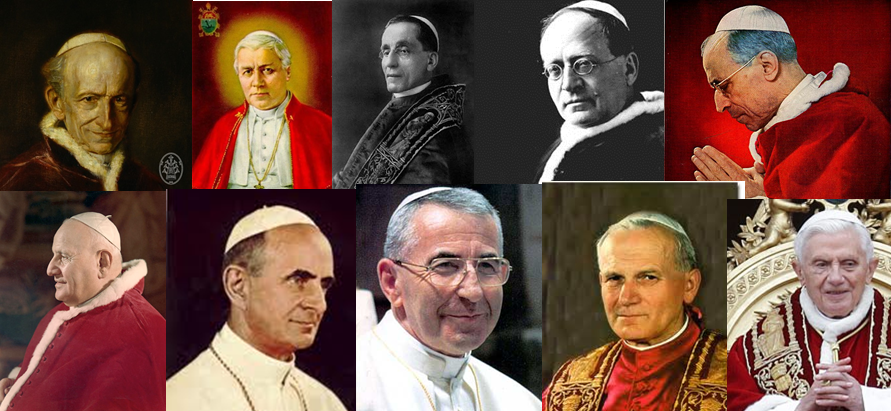
are like Time Lords…

…they keep on regenerating….

(and you are allowed to have your favourites!)
are like Time Lords…
…they keep on regenerating….
(and you are allowed to have your favourites!)
My first reaction to the news of the pope’s resignation.
A couple of other reactions in quick succession:
1) We won’t get the third encyclical in Benedict’s Faith Hope and Love trilogy.
2) Why didn’t he wait until the end of the Year of Faith?
3) Is it something more than just tiredness? Has he received a diagnosis of a more threatening nature?
4) What now? Will he keep writing books in the monastery?
5) Will there be a valedictory service?
6) What do we call him after Feb 24th?
7) Will they let him have a cat now?
I love Pappa Benny. I pray for the Church, for the Holy Father, and for the Holy Spirit’s guidance in the selection of his successor. I trust that God will continue to keep the promise to Jesus made to us, that the gates of hell will not prevail against the Church built upon the Rock of Peter.
PS. Just read that the pope had been told by his doctor “no more transatlantic trips” – was the resignation timed so that there would be a pope at World Youth Day?
PPS. This act should finally put paid to the old liberal charge that Pope Benedict is “conservative”. It’s funny, because John XXIII is often remembered for being a “liberal” when in fact he was very orthodox – he did one surprising and historic act in calling the Second Vatican Council. Benedict, often thought to be a “conservative”, has at times done quite radical things (praying in the mosque in Turkey and Summorum Pontificum for eg!). This is just the latest of his radical innovations!
It saddened me this morning to read on the blog of my one time Seminary neighbour Pastor Matt Harrison (currently serving as President of the Lutheran Church Missouri Synod) a letter concerning a case in Newtown in the US where the recent mass shooting of young children took place. As I gather from the letter, one Pastor Rob Morris participated in a civic gathering of religious leaders (both Christian and non-Christian) to mourn the death of so many innocents. In doing so, he unwittingly violate the current norms of the LCMS with regard to “joint worship”, and has since, under direction of the Pastor President, issued a full apology.
I know that in today’s context, fidelity to the unicity and salvific universality of Jesus Christ and the Church (as the Vatican’s Dominus Iesus put it in 2000) can come into conflict with the prevailing post-modern, syncretistc approach to religion. This is especially so in situations which require us to show sensitivity to the pastoral needs of others. This is an issue which the Catholic Church struggles with just as much as the LCMS.
While both the Catholic Church and the LCMS are concerned to give witness to Jesus Christ as the only Lord and Saviour of all mankind, we tend to have a different approach in particular circumstances. Readers might find it instructive to consult the LCMS statement on the involvement of their pastors in civic “services” and compare it to the guidelines of the Catholic Archdiocese of Melbourne “Promoting Interfaith Relations”.
What one will notice is a difference of prudential judgement. We both recognise the dangers of syncretism and relativism, but the Catholic Church takes a rather more positive view of the human yearnings toward the divine than does the LCMS. Essentially, this is because the Catholic Church does not teach that non-Christian religions are entirely evil or wrong. There are, to quote Dominus Iesus “elements of truth and grace” in these religions as well.
Another part of the difficulty stems from the way in which the LCMS defines a worship service. Any event in which scriptures are read and prayers are said constitutes such an event in their definition. You will recall that one of the difficulties Protestants have with Catholics “praying” to the saints is that in their book “prayer” = “worship”.
Of course, the LCMS doesn’t just have a difficulty being in a religious setting with non-Christians, they have a difficulty even praying with their Christian brothers and sisters. This is a little bit sadder. Short of joint celebration of the eucharist, the Catholic Church positively encourages us to practice “spiritual ecumenism” in the form of prayer with our brothers and sisters in Christ.
The LCMS has two main concerns: the first is fidelity to the scriptural injunctions about fellowship with idolators and false teachers and the second is their desire to give an unadulterated witness to Jesus Christ.
In relation to the current case in Newtown, I think one should ask what witness to Jesus Christ would be given if Pastor Morris had refused to be involved in an event giving voice to the grief of the people of Newtown. Jesus did not hesitate to go into places and have fellowship with people who were thought to be religiously unclean (the case of Zaccheus is the prime example) even if this gave offence to the religious leaders of his day. Nor did he ask the Syrophoenecian woman to give up her non-Jewish religious practice before he healed her daughter. In both cases they were seeking God, and in both cases he brought God to them. I wonder if in their intention to be faithful to the scriptures, the LCMS may not be applying the wrong scriptural passages to the case in hand. the scriptural injunctions against false worship The scriptural injunctions about mercy rather than sacrifice might well apply here.
To illustrate the difference in our approaches, here are a few passages that I read in Pope Benedict’s “Jesus of Nazareth: The Infancy Narratives” only this morning. They come in the context of his reflections upon the visit of the Magi:
The ambivalence of the concept of Magi that we find [in the Scriptures] illustrates the ambivalence of religion in general. It can become a path to true knowledge, the path to Jesus Christ. But when it fails, in his presence, to open up to him and actually opposes the one God and Saviour, it becomes demonic and destructive… (p93)
[The “wise” men] represent the inner dynamic of religion toward self-transcendenc, which involves a search for truth, a search for the true God and hence “philosophy” in the original sense of the word… We might well say that they represent the religions moving toward Christ, as well as the self-transcendence of science toward him… (p95)
The key point is this: the wise men from the east are a new beginning. They represent the journeying of humanity toward Christ. They initiate a procession that continues throughout history. Not only do they represent the people who have found the way to Christ: they represent the inner aspiration of the human spirit, the dynamism of religions and human reason toward him. (p97)
Pope Benedict is no syncretist, and certainly no relativist. You will recall, of course, how Pope Benedict, at the 2011 Assisi Gathering of world religious leaders, changed the format significantly to make it clear that this gathering was not a joint worship event. But what he does give voice to in these passages from his latest book, is the very distinct difference in judgment between the Catholic Church and the LCMS about what is going on in the hearts of human beings when they turn to the “transcendent”. The LCMS follows the traditional confessional Lutheran judgment that any kind of seeking after God apart from a full and orthodox confession of Jesus Christ and the Holy Trinity must necessarily be a step away from God rather than toward him. The Catholic Church takes a rather more positive view, and at least allows that if they are not against Christ, then they may well be moving toward Christ and the fullness of Truth. In the long run, this difference of judgment is based on a difference of opinion on the state of unredeemed human nature: for Lutherans, it is traditionally viewed that all outside of Christ is darkness; for Catholics, even the light of Christ shines in that darkness.
As we say in our “Promoting Interfaith Guidelines” section “Praying Together?”,
If we cannot say the same prayer formulas together, let us at least gather together in the profound and evocative silence which is attentive to the One who transcends all.
As a footnote to all this, you may be interested in this First Things article: Roman Catholics and Confessional Lutherans explore deeper ties.
Catherine has asked me to advertise the upcoming Melbourne Catholic Singles event – her are the details:
Melbourne Single Catholics are holding a Catholic Speed Dating event for 18-55s on Saturday Feb 9th 2013 at 7pm. The venue is Sacred Heart, 116 Cotham Road, Kew. The cost is $25!!!!!!!!!!!!!!! Age groups are 18-25, 25-35, 35-45, 45-55
proceeds go to the Jesuit Mission for the work in East Timor, specifically the mobile medical clinic. fee includes wine, beer, soft drink and great food.
Bookings are essential for this event so email melbournesinglecatholics@hotmail.com
I have written a review essay of the film ‘Les Miserables’ for the latest edition of Kairos. Since that has just been published, I am now free to publish it here on my blog as well.
A couple of weeks ago, Cathy and I managed to pick up some vouchers for Photobox, a web-based photo album printing service.
We ordered and created two 100 page albums, and after a fortnight of work, I can now share both creations with you (as I await the hard copies to be delivered). The first covers my journey in Jordan and Israel, and the second covers Turkey and Greece.
Click on the pictures of the album covers below to go the Photobox preview pages. The album will take a few seconds to load, and I have found that the pictures may take a little while after that to fully load up (sometimes the cover picture appears to be the last to load), so you may need to be a bit patient at first. I suggest you click the button at the bottom right of the preview screen to choose the “Full Screen” option for the best viewing experience. Use your cursor to click on the arrows to read through the books. If the slide show starts and you want to stop it, just click on one of the pages of the book and it will stop so that you can turn the pages when you are ready.


I received a phone call from one of our commentators yesterday to ask if I was still alive or if the Bible Lands Study Tour had killed me!
So, yes, I am still here – or rather, back here, again. I have been spending a lot of time organising my diary and photos from the trip, and have made them all available on a separate page under “Other Stuff”. Click here to go to the page. There you will be able to download a full text copy of my diary to read (if such is your want).
I have also edited all my photos and created new links to each day’s collection. I have put a chronological list of links on the same page. Just click the links to view the photos (now edited) for each day. You can download any you like.
Sooner or later I will return to normal commentary.
Sunday, 16th December 2012 (3rd Sunday in Advent)
Free day in Athens
For all photos for 16th December, click here to view them on my dropbox site. If you don’t have Dropbox, use this link to sign up and you and I will both get a bonus amount of free storage space.
Today had always been planned as a free day – rather generously, I thought, as we could have left today with our itinerary completed. But had we done so, all we would have seen of this great and ancient city would have been Mars Hill, the Acropolis and Titania Hotel. (Actually from the roof of the Titania, we could see a lot of Athens, but as the lady remarked to her friend upon seeing the ocean for the first time, “And think – that’s only the top of it!”). The free day was to allow us to become a little better acquainted with what this city had to offer. Sophia had left us a list of places worth visiting – about half a dozen museums of different kinds, and a number of archaeological sites.
I determined last night that my itinerary would be: Mass at St Dionysius’ at 7:30am, then the National Historical Museum at 8:30am, followed by the Byzantine Museum, the Temple of Olympian Zeus, the Theatre of Dionisos, the Ancient Agora (as distinct from the Roman one) and the Museum of the Acropolis. We had to be back at the hotel at 6pm for mass and final debriefing meeting before dinner. I had also originally thought to go to the National Archeological Museum, but that was a bit of a walk in the wrong direction from everything else. I had also determined to do this walk on my own, for a number of reasons. The first is that I move at a faster pace in general to others when exploring a city for the first time. I like to stay on the move, do a quick reconnoiter, take as many pictures as I can to examine in detail later, stop for food only when I am hungry, stop for rest only when I am tired, and change my itinerary without notice should something more interesting turn up. The second is that I didn’t want to have to negotiate what I wanted to do with anyone else. But the third is something that has been the case on this whole trip. It is sad to say, but true, that I have not actually developed any real friendship or partnership with any of the other tour members. I have gotten on with all them more or less well, but I have not had an actual “friend” or “buddy”. I have missed that. I could think of any number of people whose company I would have loved to have had – chief among them my wife Cathy – and whose presence would have enhanced every shared experience, but that has not been the character of this trip, and perhaps my greatest regret concerning it.
I had a choice of four masses at the Catholic Cathedral of St Dionysius the Areopagite (my thoughts and prayers naturally turned to my boss and local ordinary, Archbishop Denis Hart, for whom one could say this is his “name church”): 7:30 and 9:30 Greek, 11am Latin, and 6pm English. The final one was out as we would be celebrating our last group mass, the Latin was tempting, and the 9:30am would have eaten into my itinerary, so I chose to go to the 7:30am – which meant an early start without breakfast. the Cathedral is undergoing repairs at the moment (with funding from the local government as far as I could tell from the sign out the front), so its exterior aspect was not very photogenic. It is in the same street as the hotel – “just go out the door and turn left”, Sophia had directed. It is in the same street as the National Library, the Academy (as the University is appropriately and historically named), and other major public buildings, so the street scape as a whole is rather pleasant in terms of Hellenic architecture. The Academy has statues of Plato and Socrates out the front and owls on the pediments of the building (symbolising wisdom?), as well as Athena and Hermes(?) on very high pedestals.
In style St Dionysius’ church is indistinguishable from any Roman Italianate church built on the basilica pattern. The congregation of about 100 was fairly young and almost entirely Filipino and other assorted Asian people – migrant workers, I assumed. There were no beggars out the front of the church at this hour (I am told that later in the day there were many) – perhaps because the professional beggars knew that these people had little to offer them. The service was led by a priest and an adult server vested in an alb (both with beards in the Greek style), and by a male cantor. The cantor read the first reading and the psalm, and the server read the epistle (which made me wonder if he was not perhaps a seminarian). There was no accompanying music, and the mass was largely spoken, but the cantor led us in singing the Kyrie in Greek (naturally), as well as the Gospel Acclamation and Agnus Dei (also in Greek). He also sung a Greek solo chant at the communion (not a hymn), and closed the mass with a couple of verses of what I recognised as “O Come Divine Messiah” – although I did not recognise the language this was sung in. The priest used the third Eucharistic prayer. I thought this was appropriate, as it is based on the Anaphora of St Basil as far as I know, and would originally have been in Greek anyway. I would have been very interested had the Roman Canon been used (Eucharistic Prayer 1). A reader may be able to tell me if the original Roman Canon – going right back to the earliest centuries – had been in Greek rather than Latin, or whether it had been composed originally in Latin in the first place. The Gospel reading was, of course, in Greek, but not in the original New Testament Greek as I thought might have been the case (I had the Universalis app on my iphone to guide me which gives the original Greek text for the Gospel). During the sermon, which was “all Greek to me”, I had time to look at the material I had picked up in the church as I came in. Interesting among these was the pamphlet for the Year of Faith, which gave both the Nicene and the Apostles Creed in Greek. I noticed that the Filioque was not included – either on this pamphlet or in the liturgy itself. The other interesting document was a pamphlet addressing the Greek government’s refusal to recognise the Catholic Church with legal status, grouping it among the “foreign dogmas” of all non-Orthodox Christian churches in Greece. This pamphlet rather pointedly listed all the recognitions, favours and kindnesses shown to the Greek Orthodox Church in other Western countries belonging to the European Union, and pointed out that the Greek Government’s reasons for refusing to recognise the Catholic Church in Greece are parallel to the Turkish Government’s rational for refusing to recognise the status of the Greek Church in Turkey.
After the mass, I had some time to look around and to light my customary three candles. There is a very nice large marble font in the baptistery, a painting of St Paul among the Areopagites, and a large painting of St Denis above the altar. The dome of the apse is decorated with a picture that appears to be the apotheosis of St Denis – I was not sure what to make of this. I then left the church and walked the short distance to the Historical Museum. It was closed, despite the fact that the sign out the front said it would be open on Sundays at 8:30am (with free entry on this day). Examination of the much smaller notice on the door said that the opening time was 9am, and instead of waiting around, I decided to head for the Byzantine Museum some distance away, as it would be sure to be open by the time I arrived there. I walked up past the House of Parliament (known in Greek as the Syntagma), where I passed a florist and stopped to take a picture with the intention of surreptitiously including in the photo the large number of riot police that were gathered on the street (wearing body armour and carrying helmets). The florist came out and wished me good morning and asked where I was from. When I said Melbourne in Australia – he responded “Yes, I know it well, I used to live in Caulfield for a long time”! I walked on up the street, passing many embassies, including those of Egypt, Portugal and Azerbaijan. I also noted as I passed the National Gardens and the Benaki Museum – also both on Sophia’s list of places that could be visited – and decided that I would see these on the way back.
The Byzantine Museum was open when I arrived. There were very few people here – most of those standing around I took to be plain clothes employees and guards. The buildings and central garden of the Museum are very pleasant, and I determined to have breakfast afterwards in the cafe on the other side of the broad courtyard. The cost for entry was four euros. I could have spent all day quite happily in this museum. It has many collections and many useful explanations of the history and culture of the Eastern Roman Empire. I studied Byzantine History at University, and have had a particular interest in the Byzantine ruins everywhere we have travelled on this trip. The collection of icons alone are worth examining closely. Not surprisingly most of the exhibits are to do with the history of the church in the Empire. There was one interesting exhibit detailing the way in which many temples, including the Parthenon, were converted into churches rather than being destroyed. This in part explains the modern Greek Christian mentality which sees no decisive break between the pagan past and mythology and their own Christian faith. Mindful of my full itinerary for the day, I spent just a little over an hour in the museum taking lots of photos (see the link above).
Coming out of the museum, the cafe was just on my right, and I realised I was terribly hungry. I entered in and ordered a baguette and a coffee – I was the only patron, and decided to sit out in the courtyard. given that it was about 7pm at home, I thought I would use up some of the credit on my TravelSIM phone and ring my family. We had a long chat – and I realised that it would probably be the last call that I would have with them before leaving tomorrow. After the phone call and the brunch, while sitting there in the beautiful fresh air and sunshine, I decided that the day was just to wonderful to waste hanging around inside museums. I therefore gave the Benaki Museum a miss, and went into the National Gardens to sit and enjoy what Sophia called “one of the only green areas of the entire city”. There are no lawns in this garden, but winding paths through lush plantings of trees and bushes. There are little features, such as a small animal zoo for children with goats, rabbits, ducks and chooks, and many people jogging or walking their dogs. I walked a fair way into the gardens, and then came to an entrance on the eastern side. I had just turned around to try to get my bearings, when I heard a stamping noise behind me. Turning, I saw outside the gate on the other side of the street, a sentry guard in traditional Greek dress: hat with a long tassel, a tunic like a short surplice, a kilt-like skirt, white stockings up to the knees, and big shoes with enormous pom-poms on them. He was now standing stock still, after the manner of the guards at Buckingham Palace, be there was no doubt that the stamping noise came from here. As I was photographing him, I noticed just the barest hint of a smile on his face. As I was watching, a soldier in regular fatigues came and straightened out the tassel on the guard’s hat and the folds of his sleeve. It was the most disconcertingly intimate action to observe on man attending to the dress of another man as if he were a shop window mannequin. It occurred to me that if this was a guard, he must be guarding something, if only ceremonially. I looked through the wrought iron fence behind him and saw quite a extravagant mansion with beautiful gardens. I looked this up on my “city maps 2 go” app, and learned that it was the Maximos Mansion – the “seat” of the prime minister (although the information hastened to add that the Prime Minister doesn’t actually live there – it is rather a centre for various government offices).
So I reentered the gardens and sat down in a pleasant place and lit my pipe. This is wonderful, I thought. I am thoroughly enjoying myself. So far I had simply followed my instincts and used my eyes as a compass and I had found some wonderful places that seemed to speak to me of the heart of Athens. I had not made any silly choices or decisions either…
Then I heard some band music in the distance. It appeared to be getting louder. I got up from my seat, and looked up the street to see a military brass band in the distance leading a whole brigade of the same traditionally dressed guards as the one I had already encountered. I rushed up the street to try to get closer – this was not only a photo opportunity – it was a video event! I was too late, however, they veered left off the street into what appeared to me to be an entrance to the gardens. So I reentered the gardens and tried to catch up with them inside – only to discover that they had in fact entered a military compound in the northwest corner of the gardens, quite separate and surrounded by a high wall. I could hear the music and the stamping and marching going on on the other side of the wall and was frustrated by the fact that I could not see this extravagant display of military silliness. I stood up on a garden bench, to try to get a view, and turned to find myself face to face with a young Greek youth with a face full of excitement. He said something to me, and I apologised for having no Greek, and then he ran off around the corner. Okay, I thought, he seems to know where he is going, so I followed him. There was now a small crowd gathered at the gates to the entrance of the compound. I arrived just as the band was, well, disbanding, but in time to see some wonderful goose-stepping from the small troop of guards. Then the gates opened, and the little crowd surged forward into the compound. Oh well, I thought, I’ll tag along and see what there is to see. But I had hardly gone very far when I noticed the gates were being closed behind us – somehow I must have become involved with a private party. I slipped back out the gates just in time to find myself back outside on the empty street – empty except for the same young youth whom I had followed here. He was beaming – he had obviously had his treat for the day. And so had I, I thought.
I walked around toward the front of the gardens again (noticing the sign on the gate of the compound which read “Basilissis Sophias”), and walked back down toward the Syntagma. It was just before noon, and out in front of me, once again, goose-stepped a small brigade of three more of the traditional guards. They were being escorted by a regular soldier and heading for the Syntagma. Aha! The changing of the guard! A crowd had already gathered there to, and this time I caught the whole bizarre ceremony – it was like watching a liturgical ceremony performed by clockwork ballet dancers. I walked on into the Syntagma Square, where there was lots of music and events going on, including a skating rink. In one corner, a Father Christmas was posing for photographs. He saw me watching him with the people, and waved for me to come over and have my picture taken with him. I shook my head – “Warum nicht?”, he enquired. “I don’t need a picture with Saint Nicholas”, I answered. “Nein, Ich bin nicht Santa Claus,” he continued in German, “Santa Claus ist in Deutschland – heir ich bin Santa Basileos.” A curious fact, but true. Still, I didn’t accept his invitation to have my picture taken, not even with St Basil! In a way, I regret it. It would have been a most unusual souvenir.
I walked on, following my nose, and came to a church. There was a tour group outside getting a little lecture from their guide about the church, but not in English. This church is easily distinguished by the separate bell tower. According to my “city maps 2 go” app, the church is called “Hagia Triada” and there was an added note in brackets “Rosike Ecclesia” (Russian?). The door was opened, so I went inside. It was after noon, so the liturgy had already concluded, but I found that I had stepped in on a private baptism. I was just in time to see the little naked baby, all shiny from the anointing oil, dunked three times in the large font in the name of the Father, and of the Son and of the Holy Spirit, before being placed in the large white clothes waiting in the arms of its mother and grandmothers. What a joyful moment! but I was intruding, so I didn’t remain long.
Still wandering along, I came to a market/fair type event, with merry go rounds and what not. The stalls were selling all kinds of things, but of a generally high quality. Having too many euros in my pocket, I bought a few more Christmas gifts, before moving on to the Temple of Olympian Zeus, entry to which is included in the same ticket as one uses for the Acropolis. The temple precinct is an area about the size of a soccer field (perhaps a bit bigger?). The Acropolis looms large above it to the south, on which side may also be found the Arch of Hadrian, and to the east and west there are some more minor ruins (including those of a very old – 5th Century? – Basilica, which I had read about in the Byzantine Museum this morning). But the area around the remains of the temple are open and broad – and practically empty. It was an oasis of space and quite after the crowds on the streets. I sat down for a while in one corner in the shade, where I could take in both the monumental edifice before me and the Parthenon perched on the hill behind it. I was carrying my shopping with me and it was beginning to become warm, so I needed some rest. A cat sauntered up, and jumped up to sit beside me on the bench. I said hullo, but I don’t think it spoke English. I did here a young family nearby speaking English, however, and with a decidedly antipodean accent. “Hullo,” I called, “where are you from?” “Brisbane,” came the answer. “Thought so. Melbourne for me.” And then, to the small boy, “Have you been up there?”, pointing to the Acropolis. “Oh yes,” he grinned. I’m afraid after that he would find the Temple of Zeus a bit boring.
I decided finally to go back to the hotel and off-load my shopping and a layer of clothing before heading on to the Agora and the Acropolis Museum (passing an excavation of Roman Baths in the street, as you do in Athens). As it was, it was at this point that my day changed from being quite magical to a bit of a slog. The detour via the Hotel put me behind time, and so I missed the 3pm closing of the Agora. In addition, it was warm and a bit of a walk to get there, so I was even more footsore and tired than before. The streets around the Ancient Agora are filled with people – and there is a “flea market” (as Sophia called it) there as well. The stalls here were less classy than the one’s at the fair and more a down-market “Trash and Treasure”. Some of the types hanging around here gave me reason to look to my valuables – and to my person also. But the cafes and bars were all full to overflowing – not with tourists as far as I could see but with locals. I was tempted to stop and order a beer and a bit to eat, but, being annoyed with myself for missing the entrance to the Agora, I was focused on seeing as much as I could of the old Athenian rocks as possible. I did get into the “Library of Hadrian”, which was just closing, but the chap at the entrance let me in for free to have a quick look around. Sites about which I know nothing make very little sense on the first encounter, but I took lots of pictures and also photographed the explanation signs for later reading. There were the ruins of a large cross-shaped church on this site. Then I walked up passed the Roman Agora, and walked right around the perimeter of the Ancient Agora in the hope of getting better pictures. I did manage to do so, on the high side between the Agora and the Acropolis, before coming around again to the Roman Agora. A couple of other things in this area – an old 18th Century mosque now used as a folk art museum, and, within the confines of the Agora, the Church of the Holy Apostles – built in the 10th Century and still standing complete and intact.
Now I was back in the retail area – a small street of shops. I noticed one, specialising in replica armour, swords and helmets – selling some items I was interested in, and was about to step in the door, when Fr Peter emerged from the very shop. Despite us all having basically the same choice of places to go and see today, he was the first of the tour group that I had encountered on my wanderings. He too had missed the Agora, and I pointed to him the directions to walk around it.
Now I was really tired, and decided to head for home again. I arrived back with blisters on my feet at about 4pm. I bought myself some internet time, did a bit of banking and picture uploading, and then went up on to the roof to smoke my pipe and watch the lights come on at the Acropolis.
It had been a wonderful day (if a little frustrating the way it ended – but that’s what happens when you just walk out of your hotel door and turn left…), and a good ending for this pilgrimage in the steps of Jesus and St Paul. Tonight we will celebrate our last mass together, and then have a time of debriefing on the experience of the last five weeks. Tomorrow we have a plane to catch.
I began this journey a month ago the same way I began my walk this morning – I went out the front door and turned left. Like Bilbo Baggins on his great adventure, I have seen that the road indeed goes “on and on”, but now I have been there and it is time to go back again. The return journey will take the best part of two days (by the calendar, if not by the stop watch), but we have been away so long – the longest I have ever been apart from my family – and now it is definitely time to go home.
I wish to thank the Catholic Theological College for offering this study tour, the Ecumenical and Interfaith Commission for sponsoring me to undertake it, Rosemary Canavan and Tony Dean for being out tour leaders, all my fellow travellers – and above all you, dear reader, for sharing the journey with me on these pages.
Saturday, 15th December, 2012
Athens and Corinth
For all photos for 15th December, click here to view them on my dropbox site. If you don’t have Dropbox, use this link to sign up and you and I will both get a bonus amount of free storage space.
I began this morning by going up to the roof to take some pictures of the panorama in the dawn light. This view is indeed one good thing about this hotel. The location should be good for tomorrow too, as we have a free day and most of the museums and other interesting places are within walking distance.
We boarded the bus for the Acropolis at 8am, and road around to Mars Hill, the scene of Paul’s meeting at the Areopagus (cf. Acts 17), and also the scene of John Paul II’s meeting in 2000 with the Orthodox Archbishop of Athens. I suppose the hill takes its name from the fact that it consists of a large lump of red marble, about the shape of a tiny Ayers Rock. The marble is not of a very good quality, and appears to be crumbling away with the wear and tear of the many visitors who climb it. Unlike Ayers Rock, visitors are positively encouraged to climb this site, and a new steel stairway has been constructed to facilitate this for all but the most frail and least adventurous. Nevertheless, you have to watch your step, as the marble is quite slippery, and you wouldn’t want to end up at the bottom on your bottom. There are two directions from which one may approach this rock – from the north, that is, from the ancient Agora, or from the south, which is the normal approach of the modern tourist en route to the Acropolis which is directly toward the east of Mars Hill. It is on this latter side that a large bronze plaque is attached recounting the whole of Paul’s speech to the Areopagites in the original Greek. Here, before this plaque, Fr Thin read the speech in English to us. We then climbed up onto the rock and wandered around a bit, taking pictures and trying not to lose our footing and slide down the other side. Having seen pictures of this spot labelled “Areopagus” in books and on the internet, I had always wondered what the philosophers of Athens were doing perching themselves on such an exposed and uncomfortable piece of rock. In all probability however, and according to Luke’s own account, the meeting and the speech took place at the base of the Agoran side of the rock, not the side with the plaque on it.
From here we walked up to the entrance to the Acropolis. I felt that we were a part of some peripatetic school ourselves, because our divine Sophia would stop us and sit us down before every significant spot and give us a detailed lecture on what we were about to see before leading us on. I appreciated this – especially compared to the sort of cursory introduction I overheard other tour guides giving their charges – but I was chafing a bit to be let out of school and allowed to rush about taking as many pictures as I could in our allotted “free time”! Thankfully, she gave us plenty of this. The Acropolis was already quite crowded by the time we entered – and this is the “off season” – God knows how congested it must be in the peak tourist season. The main attraction is, of course, the Parthenon itself – it is such an iconic image of Ancient Greece, and has had such a universal impact upon architecture that one gets a kind of deja vu experience just being here.
Of the vast original complex on the Acropolis, there are three buildings more or less standing today: the Propylaea at the entrance, the Erechtheum, and, of course, the Parthenon itself. The Erechtheum is a very attractive building, decorated with Ionic columns rather than the Doric columns of the Parthenon, and distinctive because of the six columns in the shape of women – technically “caryatids”. My first encounter with these figurine-columns was when I was studying classics at Adelaide University, and my tutor pointed out to us that the copy of an caryatid from the Athenian erechteum in our own museum was older than the caryatids on the Acropolis itself. This is because all the figurines on the Acropolis are copies – the originals are in the Acropolis Museum (except for one that Lord Elgin nicked along with half the marble decorations from the Parthenon itself). The copy in the Adelaide Uni classics museum was the first out of the mould when the reproductions were made. A little known fact about the Parthenon is that it was used for about 1000 years as a Christian Church, dedicated, not to Athena, but to the Blessed Virgin. Calling it the “Parthenon” remained appropriate however, as it means “a room for a virgin”. And it was even used as a mosque for a while during the Ottoman period, before being blasted to smithereens during the Venetian-Turkish conflict in 1687 – something for which both sides can be jointly blamed. The Turks were using the Acropolis as a fortification and storing their gunpowder in the Parthenon – the Venetians scored a direct hit from their canons, and the whole thing went sky high. The middle building – the ancient church-mosque – was blasted out of existence, and the rest of it pushed upwards and outwards. The architects, engineers and archaeologists working on the site have been piecing it together ever since.
This means that one can never hope to see the Parthenon in the modern age without seeing some kind of scaffolding surrounding it, as work on the restoration continues constantly. The good thing is that with every passing year there is more of it to see. Since a visit to the Acropolis of Athens is one of the many things that you should do before you die (in addition to swimming in the Dead Sea), may I suggest that if you are on a limited budget and can only make one trip to Athens, you will get your best money’s worth if it is the last thing you do before you die.
We finally dragged ourselves away from the jewel in Athens’s archaeo-touristic crown, and reboarded the bus for the trip out to the Corinthian peninsula, a bit over an hour’s drive south of Athens. The drive there is along the coast, but the coastline today is quite built up and the road itself obscures some of the better views (many long tunnels and toll stations), and as a result is not very interesting. You get a good view of the island of Salamis just off the coast – Greece’s second largest island after Crete. This island has an important place in Athenian history, as it is to here that the Athenians retreated during the war with the Persians and then won a decisive sea battle against them in 480BC before resettling on the mainland and preceding to construct the Acropolis complex in thanksgiving to their gods.
The interesting thing about the location of Corinth is that it is just south of a narrow isthmus of land joining a large peninsula to the mainland in the north, near the ancient village of Isthmia (the word “isthmus” comes from the Ancient Greek for “neck”). This curious land formation was of particular annoyance to the ancients, as it is only 6.3km from one side to the other, and yet to sail right around the peninsula would take them a week. Their solution was to simply offload the cargo on one side and drive it across to the other where they would reload it on another boat. This cumbersome solution was finally bettered in 1893 when the Corinthian Canal was chiselled out from one side to the other, allowing at least small to medium sized vessels to sail right on through. It really is something to see (not on the “must see before you die” list, but still quite neat). It is a mini version of the Suez or Panama Canal, and as a feat of engineering you wonder why the Romans didn’t try it ages ago (it certainly would not have been beyond them).
We stopped for a break here and a quick snack as we were in a rush to head on to the site of ancient Corinth, which closes at 3pm in the afternoon. Nevertheless, I did do some souvenir shopping here: a book on St Paul’s travels in Greece and (cajoled by my fellow pilgrims) a piece of traditional Greek head gear. I objected at first that it was “too silly”, but they pointed out that this had not prevented me from buying headgear in the past, and that my collection would be incomplete if I didn’t purchase a hat in Greece (in fact, I didn’t get a kippah in Israel either – as the French knights say in Monty Python’ Holy Grail say: “He already ‘as one”), so once again, a hat-lover and his euros are soon parted…
As a final destination on our journey, Corinth was a real treat. There is a new modern town called Korinthos, but the ruins of the ancient city are tucked away in the middle of a little village about 4km away called “Archea Korinthos”. Towering above the archaeological site is the “Acrocorinth”, or the Corinthian Acropolis – the site of continual human habitation from Neolithic times to the end of the Middle Ages, but today abandoned, leaving behind ruins of temples, churches and mosques, but principally fortifications. Of course, whenever I see a high mountain, my desire is to ascend it in some manner, and I enquired of Sophia if it was possible to drive to the top and whether this was on our itinerary. The answer to these questions was “yes” and “no”, in that order. Oh well, something to do next time.
But we did have an extensive time in the site below. there is an excellent museum here, with some remarkable pieces in it, including a famous statue of Caesar Augustus depicted as a priest. Two of the most interesting items, from our point of view, are a block of marble decorated with menorahs, and another block, not so skillfully incised, which seems to read “synagogue of the Hebrews”. Both these blocks were apparently found in the shopping precinct, where they had probably been reused – as the synagogue would not have been placed here. Yet this is proof that there was a Jewish community in Ancient Corinth as Luke tells us in the book of Acts (Acts 18). Paul spent a year and a half living, working (as a tent maker) and preaching here – longer than anywhere else on his missionary journey’s except Ephesus. So when we walked around on the old Roman roads, and looked around at the old shopping precincts and agora, we could say with certainly “Paul walked here” and, with less certainty, “Paul’s tent making workshop could have been here”. But it is in fact possible to identify one spot where Paul definitely stood (an even better pinpoint than the theatre at Ephesus). In Acts 18:12-16, Luke tells us about an incident when Paul was dragged before the proconsul Gallio at the “tribunal”. This spot is the “Bema”, the place of judgement in the agora, and this structure has been excavated, and positively identified, with even the seats of the judges visible.
We celebrated mass here, the last outdoor mass at a “sacred site” on our pilgrimage. The birds were singing, the sun shining weakly through the clouds, hardly a breath of wind. It was one of those moments when the past was not obscured by the present, and it felt as if there was a very thin veil between us and the original Christian congregation in this place. In the back corner of the site is a 6th century church, largely intact, and just outside the site is the modern Archea Corinth Orthodox church, so there was even a sense of continuity there too. As the words of consecration were said by the concelebrating priests, I recalled that it was to this community that those words were (as far as we know) first committed in writing, in the first letter to the Corinthians (chapter 11). Thinking back on the journey, it has been those moments and places in the country settings that have moved me most – the baptismal site at the Jordan, the Sea of Galilee, the baptismal site in Philippi, and now here – perhaps precisely because there was no city and noise blocking the vision of the past.
During our drive back to Athens, I had a conversation with Mary Ann, Rosemary and Sophia about the need to be constantly learning about one’s faith, and, as Mary Ann put it, the baptismal obligation to grow in faith. We talked about the unfortunate separation in the Catholic tradition between biblical scholarship and “theology”, and the “academising” of theology so that it daunts simple Christians who want to learn more. This was our last journey with Sophia, as we are on our own tomorrow and will just have the bus to drive us to the airport on Monday morning, so we farewelled her and our driver Panos on our arrival at the hotel. Sophia informed us that in our short week in Greece we had traversed 1260kms.
As we had already celebrated mass, there was just dinner to have in the evening, and I dressed and went down before Peter. In fact, I went down before everyone, as I was the only one in the entire dining room. I must have had the time wrong. I could have gone back and come down again later, but the food was already out and going cold, so I served myself and ate alone (in fact the food was already luke warm…). I then spent the rest of the night working on pictures and the travel blog, before retiring.
Friday, 14th December, 2012
Meteora and Athens
For all photos for 14th December, click here to view them on my dropbox site. If you don’t have Dropbox, use this link to sign up and you and I will both get a bonus amount of free storage space.
I had another bad night’s sleep and was glad when finally Fr Peter stirred and I could get up without disturbing him. After my shower and breakfast and packing my bags I went for a bit of a walk through Kalambake towards the rock mountains to take some photographs. It was freezing cold – the puddles were frozen – and not for the first time, I wished that I had packed my thermal long-johns.
We left at 9am and first went into the town where several members of the group needed to use the ATM or visit the post-office. The bus dropped us all off to wander up and down the street for a bit. It was very cold and I asked Sophia if there was somewhere warm we can wait. “In here,” she said, and directed us into a store. Inside it was warm, there were nice couches to sit on, AND it was full of sweets and biscuits and chocolates and everything nice. it was a “zacharoplasteio” – literally a “sweet fashioner’s”. there was a whole glass fronted counter filled with about 25 different kinds of biscuit. I thought I would buy a bagful to share with the rest of the team when we were travelling later on. “One of each, please,” I asked the shop owner (the “sweet fashioner”). When he handed me the bulging bag, I asked “how much”, and was told “3 Euros”!
Back on the bus, we took the road up to the top of the Meteora mountains to St Stephen’s monastery. St Stephen’s is in fact a convent today – although the Greeks call every religious house a monastery, whether for men or for women. They have no religious orders, partly because all religious houses are under the authority of the local bishop (or of Mt Athos, or possibly the Ecumenical Patriarch in Constantinople), and partly because they have no equivalent to our friars and non-cloistered religious. Originally only monks lived on the mountains of Meteora, but at one stage after the Second World War, when the number of monks had decreased to the point that there were only a dozen or so monks on the whole mountainside, the local bishop installed some communities of women in the vacant monasteries. Before the War, there was no road access to the monasteries – you will have in mind, of course, the famous “basket-on-a-rope” method of access to some of them – but the German army built a road right to the top and over the other side during the occupation because they were using the peaks of the mountains as lookouts up and down the Valley of Thessaly. This road has been upgraded considerably and today coaches of tourists are easily able to make the ascent in comfort.
We stopped for several photo shoots before reaching St Stephens. The monasteries are perched like the nests of storks on chimney tops, and their walls seem to grow straight up out of the sheer sides of the rock. There are visible in the holes and caves of the cliff faces small dwellings – the cells of hermit monks, some reached by ladders. It looked in part like Petra or Cappadocia, but these are still in use. There has been a resurgence in the life of these communities, and, in addition, there is money to be made from the tourist trade. This in fact is what powers about 90% of the life in the town of Kalambake, and it is why some of the monasteries are open to the public (at least, some sections). We accessed St Stephen’s by means of a small stone bridge which spanned a deep and narrow ravine separating the island of rock on which the monastery was built from the “mainland”. The walkway down to the bridge was slippery with ice and you had to watch your footing. A slip here could mean a long downhill journey…
St Stephen’s is like a small a fortress – we were amused at the spikes on the outside of the wooden entrance door. We walked through the entrance and across the courtyard to the entrance of the monastery’s church, which is one of its three major attractions – the other two being the small museum and the huge view over the valley from the other side of the monastery. The church suffered damage from German bombing during the war and is still undergoing restoration. Thankfully, although the cylindrical “dome” of the church was destroyed, much of the main sanctuary and nave was saved, including the ornate hand carved wooden iconostasis from the 17th Century. The narthex on the other hand lost most of its roof, and so there is an ongoing replacement of the iconic frescos here. These are very confronting as they are all on the theme of martyrdom – in accordance with the dedication of the monastery to St Stephen the Protomartyr. So there are plenty of scenes of holy men and women being burnt at the stake, flayed, boiled alive, having bits and pieces of their bodies chopped off, etc. etc. Some of these are very up-to-date, and include an icon of Patriarch Gregorios V of Constantinople being hanged from the gates of the Phanar in Istanbul for his part in the Greek riots in the 19th Century (a small detail Hakan forgot to mention to us when we visited).
We went into the museum which was small but well stocked with liturgical items (including vestments and thuribles and manuscript books and ritual crosses). Unfortunately, no photos were able to be taken in either the church or the museum. We then visited the rather nice little store that the nuns run, with a lot of handmade items. It was good to enter a warm room – the church had been freezing cold and even my toes were becoming numb. I selected a small icon of St Stephen and a small orthodox cord “rosary”. When I went to pay for them, my attention was taken by a wooden bread stamp under the glass of the counter. I inquired about it, and the nun told me that it was made in Mt Athos and is of the kind used to stamp a pattern on the eucharistic bread when it is being cooked. It has a cross shape made out of five squares, three of which have the “IX XC NI KA” symbol on them. Before the consecration, the loaf is cut into nine pieces according to the pattern, and the central square alone is reserved to be consecrated in the anaphora. The rest is handed out at the end of the service as “blessed bread” for the faithful to take home with them. A liturgy addict and his euros are soon parted and I purchased this as well. I doubt if I will ever use it for sacred purposes, but I thought it would make a wonderful way of decorating our Easter bread.
We reboarded the bus and descended down the other side of the mountain onto the wide plain below. Sophia then thought we might enjoy a visit to a local icon workshop. The story behind this shop is that some decades ago a local young man wondered how he might enable his large family to survive economically, and determined to go to the Holy Mountain of Athos to learn the art of iconography. Returning as a priest, he taught the art to his brothers and they started the family firm of Pevka, which today continues to hand make icons of high quality. The Church of Greece and the Vatican are among their clients, and they showed us an icon which is being prepared at the moment on commission for the Vatican. Also proudly displayed was a picture from the meeting of Pope John Paul II and the Greek Orthodox Archbishop of Athens at the Areopagus in the year 2000. On this occasion a large icon of St Paul was situated between the two leaders – the icon had been made by Pevka.
From the outside, the workshop appears just like any other factory (indeed it is situated among other factories). Inside, we entered a large show room with shelves full of icons of all kinds and colours, and with walls decorated with icon frescoes. After a welcome serve of grappa about 90% proof), we were shown into the wood working room where the board and canvas is prepared. This room was very comfortable and warm – heated by a wood furnace, and had that wonderful smell of wood shavings. They prepare the canvas by a traditional method, which involves stretching and coating the cloth in various natural animal glues and then firing it in a kiln and rubbing it smooth to make a kind of cloth card. The icon is painted directly onto this cloth before it is glued to the wooden board – this preserves the brilliance of the colours of the paint.
We then went back into the show room, in the centre of which one of the brothers of the family was working on an icon of the Theotokos. A sister of the family showed us around, but Sophia did most of the translation. She seemed to be fairly at home here, and I judge that she is well known to the family. We were able to watch the painter at work for a while. He was using a very fine brush to add the final lines to the icon, but what interested us greatly was the long staff like tool with a cloth knob on the end which he used to rest the wrist of his painting hand upon so that it did not touch the surface of the painting (see the pictures!). The paints were made from powdered paint mixed with an egg and vinegar liquid, which created a “tempura” kind of paint. We were shown how the 22-24 carat gold leaf was applied with a broad brush made “sticky” with static from brushing it on the hair of the head. There were questions and answers about the process, and then…
Well, at this point, after having visited carpet, pottery and leather goods manufacturers in Turkey, I expected to be given “the hard sell”. In fact, all Sophia said was “Now you can have a look around the showroom and if you like you might want to purchase an icon.” So we were free to examine the merchandise, all of which was clearly marked with a price. I was pleasantly surprised to see how low the prices were, ranging from 15 euros for a small piece to about 190 euros for larger items. 45 euros purchased an icon of about 15cm by 12 cm, which I thought was pretty good – similar pieces at home would cost about $200. They gave us a 10% discount as well. I had always intended to purchase an icon or two while I was in Greece, and had expected higher prices, so I decided to make my purchase here. I was not alone. One of the priests bought almost a dozen, but each of us bought at least two (or, perhaps, one large one). I bought a St Joseph, a St Michael, a St Mary Magdalene (for my daughters Mia and Madeline) and a Christ icon as a Christmas gift. I also picked up a smaller icon of St Lydia, as I had been regretting not getting a memento of our visit to the baptismal site at Philippi the other day. As well as the certification of authenticity on the back of the icon, the icon writer himself also signed and dated the icon on the reverse side for us (incidentally this also demonstrated how quickly the tempura paint dries).
We were in the shop for about an hour and half, selecting our icons, getting them paid for and getting them signed. Sophia was a bit taken aback by the enthusiasm of these westerners for the icons – she had expected that our visit would only take half an hour. She confessed that she had often had qualms about taking western Christians to the workshop because she was under the impression that many object to icons. While this is true, I told her, it is only so among the more reformed groups. Many Western Christians, such as Catholics, Anglicans and Lutherans, are very keen on icons and most of our churches would have at least some icons in them somewhere. Yes, she replied, she was surprised to see that the Archbishop of Canterbury (Rowan Williams) had even written a book about icons. In any case, our visit must have seemed like an early Christmas to the Pevka workshop, and when we were back on the bus, Sophia had a boxful of additional little icons – one for each of us. I received a lovely little Theotokos.
However, as a result of our enthusiasm for this “short” visit, we were seriously behind schedule. We had a late lunch at a cafeteria before heading back on the road to Athens. We climbed out of the Valley of Thessaly at about 3pm, and into the hills beyond. We travelled down on the coastal road between the mountain ridge and the sea – that would be the last we would see of the Greek mountains on this trip. While on the journey, Sophia talked to us about many things regarding Greece, from mythology to the current economic and political woes of the country. We stopped at 6pm for a coffee break and then were back on the road again. In the darkness we passed by the city of Thebes (Thiva), seeing only the lights in the distance, and the location of battle of Marathon.
When we reached the outskirts of Athens at about 7:15pm, we were instantly caught in Friday night traffic jam caused by an accident on the freeway. It was therefore after 8pm when we arrived at the hotel. Realising that we would not have time to celebrate mass together this evening, for the first time on the whole trip we skipped mass and said night prayer on the bus. The lobby of the Titania looks like the ground floor of Myers – lots of marble and glitter – but Peter and I were not surprised to find that the room didn’t live up to the image. It is a star or so better than the last place, but is still very small, and we keep tripping over each other. The bathroom door only just has room to open into the room making it a little tricky to enter. Peter immediately struck a problem with the mechanism that was supposed to open the plug hole in the basin – it didn’t – and cut his finger in the process we called room service and he couldn’t get the plug to open either, and said that he would send a plumber in the morning… There are also few power points for recharging, no coffee and tea making facilities (we haven’t actually seen these since Turkey), and the internet is hideously expensive (and limited to the use of one appliance). I asked if there was anywhere to smoke in the hotel and was told no – only in the Olive Garden outside. But I was told that if I bought a drink in either the lobby or the Olive Garden I would get a “free” hour of internet use.
At dinner – which had no soup, nice salads (including dolmades for the first time in Greece) but awful main course (dried out food, luke warm – I think it had been sitting waiting for us for a couple of hours) and a choice of only two desserts – Ian, who had been here before, told us that we should not miss the view of the Acropolis from the roof of the hotel “There’s a bar up there too”, he said. So after dinner I got in the lift and noticed that above the 10th floor was “OG – Olive Garden”. It turns out that the Olive Garden (in which I could smoke my pipe) was not an outside area with trees in it on the ground floor but the name of the rooftop bar and restaurant. The bar area was quite full of people drinking and smoking, and was terribly overheated (as in fact the whole hotel is). I ordered a cup of coffee (the purchase price for the hour of free internet on my iPhone) and asked whether I could sit outside in the cooler air. The waitress looked at me as if I were mad – no, she said, we do not serve outside in winter – it is much too cold. Not half as cold as where I’ve just come from, I thought. I cannot quite understand why, when they have the most magnificent panoramic view of the city from their rooftop, including the Acropolis all lit up like a Christmas tree, they would not at least have a few tables and chairs out for those who wished to use them. But no, all the metal chairs were stacked up in a corner without their cushions, and no tables. So I took my coffee inside, and then went outside to enjoy the fresh air and the view.
I also took the opportunity to Skype home. As Rosemary has said, we are all now looking towards home, even though we have a whole city to still explore. As we hit our thirtieth day on the tour, I am especially looking forward to returning home. Adjusting will be difficult, however, as we have now got firmly into the rhythm of travelling and living out of a suitcase. Most of us are planning to go back to work on the 21st and making that our last day before returning to full time work in the new year. I do need to go into the office at least once before Christmas, but I am regretting having to do this, as I would have liked the time just to get used to being home before Christmas hits us.


I propose that
1) We replace the absentee monarch of Australia (who is also the Monarch of Great Britain) with an elected Australian monarchy.
2) The elected monarch exactly replaces the current monarch in the current constition.
3) The elected monarch has exactly the same powers, duties and responsibilities as those of the current absentee monarch. All the monarch's functions are carried out by his/her personal representatives (as is currently the case): federally by the Governor General, and in the states by the State Governors.
4) The Governor General and the Governors continue to be selected and appointed as they currently are, that is, by the premier with the approval of the monarch.
5) The monarch is elected to sovereignty over Australia for life, but his/her sovereignty is strictly non-hereditary.
6) The elective body is the "college of electors" comprised of the state governors and federal governor general.
7) The election of the monarch must be a unanimous decision on the part of the college of electors.

