It’s all happening in England and Wales

Here is a press statement from the Catholic Bishops Conference of England and Wales with regard to the establishment of the Anglican Ordinariate. They aren’t wasting time. The process will begin in January 2011 – before here even! – with the five bishops being received into communion. They are but the first-fruits! Then come the clergy and the people, being received as candidates at the beginning of Lent, confirmation at some time before Easter, and formation continuing to Pentecost when the clergy will be ordained. “Formation in Catholic theology and pastoral practice will continue for an appropriate amount of time after ordination.” Gosh. The Church has never moved so fast! Well, souls are at risk, I guess, and we all know what the last and greatest Canon law is (salus animarum suprema lex).

Posted in Uncategorized | 9 Comments

Why Euthanasia Laws are a bad idea

Nick Tonti-Filippini says it better than me.

Posted in Uncategorized | 2 Comments

On Condoms

You have all already read today’s (or rather yesterday’s) headlines. The Age typically goes into overkill mode by putting Barney Zwartz’s piece as front line head lines – it rather says more about what The Age considers important in the world than what the Church does.

Terra, at Australia Incognita, gives a useful list of blogs which have already treated the topic. To this I wil add three pieces by John L. Allen Jnr on the subject, including the Vatican Press Release from Fr Lombardo on the subject:

Poe signals nuance on condoms

Pope talks condoms, sex abuse, resignation and movie nights

Vatican statment on Benedict XVI and condoms

He makes a comment at one point in the second article above (on a different subject):

A second theme running through the book is a sort of exasperation from the pope about how his words or gestures are often over-interpreted, with their significance stretched well beyond his actual intent.

That certainly applies in this case too, where, as reported in Barney’s piece, this sort of speculation is now rampant:

Jesuit moral theologian Jeff King said it was significant that the Pope had highlighted intention. ”You could apply the same thing to the married couple where the husband is HIV positive … the primary intention would be to preserve life.”

That is not at all clear. The case which the Holy Father uses in the book is reportedly that of a male prostitute. Presumably he has in mind homosexual acts. The use of a condom in this situation – which can only be for the reduced likelihood of the transmission of sexual disease and can in no way be regarded as a limitation of natural conception – is as “a first assumption of responsibility,” and “a first step in a movement toward a different way, a more human way, of living sexuality.” In a sense, that is a little like saying that the passing of laws limiting abortion to the first trimester in a state in which currently the law allows abortion all the way to birth is a “first step” in moving toward a better more moral situation”. It is an “incremental step”.

The situation in married, heterosexual sexual intercourse still carries with it the double effect, both limiting the passing on of a disease AND limiting natural conception – and that means it is in a different category all together. Condoms can be used for all sorts of things (including, I remember in Douglas Adams’ “Last Chance to See”, covering a microphone when it was to be immersed in water). Condoms are just pieces of rubber that can be used for many different purposes. The only purpose condemned by the Church is when it is used as a means of birth control – the thing which, in fact, condoms are actually designed to do.

All that being said, we remind ourselves (as Gareth and Cardinal Reg do so often on this blog) of the difference between an expressed Papal opinion and the Magisterium of the Church.

But in the mean time, the secular world gets all excited, because it sees a “chink in the armour” and an opportunity to exploit it.

UPDATE:

Here are two press releases on the subject, one from Cardinal Pell and the other from Bishop Fisher:

A Statement from the Archbishop of Sydney, Cardinal George Pell
22 November 2010

POPE NOT CHANGING TEACHING ON CONDOM USE

HIV –AIDS is wreaking havoc in Africa, where the Catholic Church is heavily involved in the care of those infected and their surviving family members.
In his recent interview, Pope Benedict insisted on speaking on the basic Christian and Catholic teaching on sexual activity: that such sexual activity is to be confined to the love making between husband and wife. He urges abstinence from premarital and extra-marital sex and fidelity within marriage.
He also mentioned the possibility of a male prostitute using a condom against transmitting infection as a final step “in the direction of moralization”.
This is a delicate and difficult area, sometimes producing tragic consequences. I have not seen the German original of what the Pope said, but hard and exceptional cases can encourage bad law making.
Much work needs to be done to bring consistent, Catholic light into this grey and vexed area, while ensuring that the Catholic moral framework on sexuality remains intact.
I also endorse the brief statement of Bishop Anthony Fisher OP as faithfully representing Catholic thinking.

For further information:
Katrina Lee
Director of Catholic Communications
Archdiocese of Sydney
Mobile: 0403 950652
Email: katrina.lee@sydneycatholic.org

Level 15, 133 Liverpool Street, Sydney, NSW, 2000
Telephone: (02) 9390 5300 Facsimile: (02) 9390 5306 Email: media@sydneycatholic.org

Statement by Bishop Anthony Fisher OP
BISHOP OF PARRAMATTA
Diocese of Parramatta (For immediate release: 22 November 2010)

In his forthcoming book-length interview Pope Benedict XVI re-emphasises Catholic teaching that fidelity within marriage and abstinence from sexual activity outside of marriage is the only morally permissible approach to chaste living. It is also the only practicable solution to the HIV-AIDs epidemic.

The Holy Father calls on the faithful to “fight against the banalisation of sexuality” which treats sex as a mere recreational drug, and to seek instead “the humanisation of sexuality” as the expression of marital love.

Despite some misinterpretation in the international media, the Pope has not deviated from or altered in any way Catholic teaching on the intrinsic wrongness of contraception or on reserving sexual intercourse (‘the marital act’) to marriage, that is of a man and a woman.

Pastors have long recognised that in cases such as homosexual intercourse, conception and marital acts are not at issue. Using a condom in this situation is clearly not contraception. It is clear that even here the goal must be to move the individual to living a truly ‘humane’, that is a chaste and loving, sexual life.

The Pope suggests that sometimes “as perhaps when a male prostitute uses a condom” to protect his client from disease, this might be a sign of an awakening moral responsibility. But using condoms, the Pope insists, is still not “a real or moral solution”.

For interviews with Bishop Anthony Fisher OP please contact:
Jane Favotto – Communications Manager, Diocese of Parramatta
Tel 0418 208 280

Posted in Uncategorized | 49 Comments

Penance, Temporal Punishments and Purgatory

Following a discussion with my good friend Dr Cooper, and the helpful comments to the previous post on this topic, I think I can take this discussion a step further. My apologies at this point to Pastor Mark and Matthias for not taking the discussion immediately to scriptural points – I feel that there is a little “prolegomena” required first on what we mean by “temporal punishments”, as this relates directly to the use of “penitential language” in the doctrine of Purgatory.

Sin itself is of different kinds (and Lutherans and Catholics define these slightly differently but agree on the matter):
a) Original sin (“inherited” from our first parents, the consequence of the Fall)
b) actual sin (commission or ommission)
c) Concupiscence (the “tendancy” to sin, which Trent said was not “sin in the proper sense”, and Lutherans tend to conflate with the effect of original sin – I refer the reader to Christopher Burgwald’s thesis on this)

Then we need to outline and clarify what the consequences of sin are. As I understand it, they are:
1) separation from communion with God (loss of “friendship” with God)
2) separation from communion with the Church (from God’s ekklesia, the assembly/communion of the saints)
3) attachment to sin
4) the effect of my sin on creation and on other people
5) the imposition of penance by the Church

Again as I understand it, when the Church speaks of “eternal punishments”, they are speaking of (1) separation from communion with God. When the Church says that the “guilt of sin” is forgiven, they mean that this eternal punishment is remitted, and the sinner is reconciled to God (1) and to the Church (2). From my reading of Trent and knowledge of the history of the development of Penitential practice in the Church, “temporal punishments” specifically mean (5) the imposition of penance by the Church. This penance is imposed by the Church by her authority to “bind and loose” (I did say in my very first post on this topic that an understanding of Purgatory required the belief that the Church does this with divine authority, and that this was one of the difficulties in the ecumenical dialogue).

That leaves (2), (3), and (4) above. I have a question about (2) (see the end of this post), but for now want I to concentrate on “attachment to sin” (3) and “the effect of my sin on the world and others” (4). These are clearly “temporal consequences” of sin, and it is my thought now that part of the “confusion” that Cardinal Pole finds in the Catechism is that it does tend to include these at times under the discussion of the “temperal punishments” of sin. Eg. in CCC 1472, “an unhealthy attachment to creatures” is described as “temporal punishment”. Reg is quite right, I think, in pointing out to us that “temporal punishments”, at least in the Tridentine teachings, refers specifically to (5) “the imposition of penance by the Church” – an imposition which is by divine authority.

My thoughts on this have been clarified somewhat by consideration of what it could mean when we say that Baptism removes not only Original sin (A), and forgives the guilt of all actual sin (B), but also removes all “temporal punishment”. The only reference I could find to this was in Sheen/Joseph “Apologetics and Catholic Doctrine” p476:

REMISSION OF ALL SIN AND PUNISHMENT. Sanctifying Grace, infused into our soul at Baptism, removes every trace of sin, original and actual, and extinguishes any debt of temporal punishment which we may have incurred through actual sin committed before baptism.

I would be very grateful if someone could point me to a document of the Church’s Magisterium that asserts this (Sheen/Joseph does not give any reference), but I am happy to accept that this is the Church’s teaching. That being so, “temporal punishments” here can only refer to (5) “the imposition of penance by the Church”. It cannot refer to “attachment to sin” (3) or “the effect of my sin on creation and other people” (4), since quite obviously baptism does not remove these temporal consequences. Only “a conversion which proceeds from fervant charity can attain complete purification of the sinner in such a way that no punishment would remain” (CCC 1472). Unless if we are to say that at the moment of baptism this “fervant charity” is infused along with Sanctifying Grace would it make sense to say that Baptism removes “attachment to sin” (3). I find it difficult to see how Baptism could remove “the effect of my sin on creation and other people” (4). But perhaps here it is important to see that what both Sheen/Joseph and the Catechism are talking about is the “debt” of “temporal punishment” as regards the soul of the individual sinner, and not necessarily the temporal consequence (4) itself.

In any case, the doctrine that Baptism removes the “debt of temporal punishment” seems to indicate that the “debt” in mind is the debt of “Penance imposed by the Church” (5). This indeed is true, for the catechumen who is baptised is not required to (and never in history has been required to) do “penance” for sin committed before baptism, that is, the newly baptised are never enrolled in the “order of penitents”. Penance is required only for sin after baptism. In this way, we can see that it makes perfect sense to teach that the full “debt of temporal punishment” extinguished by baptism. Nevertheless, only the attainment of “fervant charity” can actually attain to the “complete purification of the sinner”. I think that is something that surely both Lutheran and Catholic can agree upon. The guilt of sin is fully forgiven by true repentance (perfect contrition) and by absolution (even when the repentance, though sincere, may not be “perfect” – ie. attrition), but the individual human soul is only truly purified of all “attachment to creatures” (3) by “fervant charity”. And – to take Ratzinger’s line – the “fervant charity” that purifies the soul, the “fire of purgation”, is surely the soul’s encounter with the Love of God in the person of Jesus Christ.

Co-relating all these strands is not an easy matter, and hence “confusion” will probably continue to reign on this matter. It helps if we remember that while the explicit doctrine of Purgatory arose in the West as a direct result of the penitential system (which began very early in the Church’s history, but developed differently in the East and the West), yet the penitential system cannot be said to have “created” Purgatory (although, perhaps, this is precisely what our dialogue partners may say). That would be to make the existence of an eternal and metaphysical reality dependant upon an historical development, rather like saying that the resurrection of the dead on the last day became “true” when ancient Judaism finally arrived (after centuries of reflection on the nature of Israel’s relationship with their God) at a developed doctrine of resurrection. For this reason, I continue to insist that while the categories in which the doctrine of Purgatory has been enunciatied and defined by the Church have been in terms of the penitential system, the penitential system as such cannot be regarded to be the essence of the doctrine, what Ratzinger refers to in his Eschatology as “the authentic heart of the doctrine”. He has sought to see the “heart” in terms of all the temporal consequences of sin, not only (5) penance, but (3) attachment and (4) effects on creation and others as well.

Nevertheless, whenever (such as at Trent) the Church has most clearly sought to speak of the doctrine of Purgatory, it has done so using language drawn from her practice of penance. Perhaps this passage from the Catechism which could again be helpful in this:

1460 The penance the confessor imposes must take into account the penitent’s personal situation and must seek his spiritual good. It must correspond as far as possible with the gravity and nature of the sins committed. It can consist of prayer, an offering, works of mercy, service of neighbor, voluntary self-denial, sacrifices, and above all the patient acceptance of the cross we must bear. Such penances help configure us to Christ, who alone expiated our sins once for all. They allow us to become co-heirs with the risen Christ, “provided we suffer with him” [Rom 8:17; Rom 3:25; 1 Jn 2:1-2; cf. Council of Trent(1551): DS 1690].

“The satisfaction that we make for our sins, however, is not so much ours as though it were not done through Jesus Christ. We who can do nothing ourselves, as if just by ourselves, can do all things with the cooperation of “him who strengthens” us. Thus man has nothing of which to boast, but all our boasting is in Christ … in whom we make satisfaction by bringing forth “fruits that befit repentance.” These fruits have their efficacy from him, by him they are offered to the Father, and through him they are accepted by the Father[Council of Trent(1551): DS 1691; cf. Phil 4:13; 1 Cor 1:31; 2 Cor 10:17; Gal 6:14; Lk 3:8].

That rather brings me to where I want to be in this discussion in order to speak of the Scriptural witness to the doctrine of Purgatory. As Pastor Mark and Matthias and other concerned dialogue partners should note, there is ample reference in these passages to the Scriptures. I would like to look in the future at exactly how the teaching of the Scriptures supports the Catholic teaching of purgatory.

But enough for now. I would be obliged if you could offer your reflections on what I have written here. I would be particularly obliged if anyone could answer me this question: is (2) rupture of communion with the Church an “eternal” or “temporal” punishment?

Posted in Uncategorized | 15 Comments

Imagining the Impossible…

…Doesn’t make it possible.

Once again our newspapers are full of people imagining impossible things and thinking by doing so that said things might become possible. It’s a bit like those get rich schemes where people say you have to “vision it” for it to happen. People have really begun to believe this is true. It is a peculiar 21st Century version of nominalism (Nominalism v2.1, perhaps).

I am, of course, referring to last night’s 73-72 vote in the Federal Parliament calling on MPs to gauge their constituents’ views ”on ways to achieve equal treatment for same-sex couples, including marriage”. A harmless enough motion, you say? What damage can it do? Only this: that it is an exercise in “thinking the impossible” as a step toward making it “possible”. Which in any previous age would have been dismissed as a futile exercise. But not today. Today we have convinced ourselves that if we get enough people thinking it is possible for two people of the same sex to be “married”, then it will become a real possibility.

And it isn’t just in the area of gay marriage that this happens. In 1994 Pope John Paul II wrote:

4. Although the teaching that priestly ordination is to be reserved to men alone has been preserved by the constant and universal Tradition of the Church and firmly taught by the Magisterium in its more recent documents, at the present time in some places it is nonetheless considered still open to debate, or the Church’s judgment that women are not to be admitted to ordination is considered to have a merely disciplinary force.

Wherefore, in order that all doubt may be removed regarding a matter of great importance, a matter which pertains to the Church’s divine constitution itself, in virtue of my ministry of confirming the brethren (cf. Lk 22:32) I declare that the Church has no authority whatsoever to confer priestly ordination on women and that this judgment is to be definitively held by all the Church’s faithful.

He wasn’t being mean. He was being a Realist (with a capital “R”). A 21st Century Nominalist on the other hand would say that the just by thinking that the impossible is possible we can make it so. Sorry, we can’t.

Marriage isn’t just to do with “love”. It is to do with reproduction, and a few minutes thought about what it actually takes to produce a baby (and a quick look at a school text book on human anatomy) will make it clear that marriage between two people of the same sex is an impossibility. Everyone knows – no matter how many pictures are published in our papers showing happy “same-sex families” – that same-sex sexual relations are, as a simple biological fact, utterly sterile.

Similary, ordination as a priest isn’t simply to do with “a call”. They have to do with the configuration of a man to Christ as “in persona Christi capitis”. It is only because he has been sacramentally configured in this way that a man is able to exercise Christ’s priestly service to God’s people. It should not surprise us that there is a common element here between the supporters of same-sex marriage and the supporters of women’s ordination. Both ignore the plain fact of nuptial reality. You have a man and a woman, a bridegroom and a bride. The Bridegroom is Christ, and the Bride is the Church. The Sacrificial Meal in which Chrsit is liturgically present in person of the priest is a Nuptial Meal. Thus Christ is “Priest” to the Church precisely as “The Bridegroom”. There is no getting around this fact. And so likewise, the one who, by sacramental ordination, is configured to Christ and enabled to exercise Christ’s sacerdotal office in the Church, must be male. A woman simply cannot be the liturgical “bridegroom” for the Bride.

Except, of course, in a world which imagines that by imagining the impossible it makes the impossible possible. Welcome to the world of 21st Century nominalism.

What we need is a remedial dose of Realism.

Posted in Uncategorized | 45 Comments

Sympathy for a Philosopher

I like Christopher Hitchens. Oh, don’t get me wrong, I don’t like what he says or what he believes. But I like how he says it, and I like him for his own honesty and straightforwardness. And I always liked his rather “devil may care” attitude to the enjoyable things of life. Given a choice of having a smoke and drink with Richard Dawkins or Christopher Hitchens, I would choose the latter any day. (Does Dawkins even drink or smoke?). For that matter, I really don’t think I would sit down with Prof. Dawkins if I had the choice, and I would choose Mr Hitchens over a lot of other people.

I truly think it is a great tragedy, both for him personally and for us, that Mr Hitchen’s is experiencing Stage Four (“there’s no Stage Five”) cancer of the oesophagus. It is true that he has had much to say about us believers that is both insulting and vilificatory, but I have never taken that personally, and (far from wanting to take him to court on these matters) always found him challenging and entertaining.

Part One of Terry Jones’ interview on ABC TV’s Lateline last night was a moving experience (part two is on tonight, I think). I had difficulty picturing the man on the screen as the same one that appeared on Q&A and other shows in the past. His illness has greatly weakened him.

Some parts of the interview interested me very much, like this bit on Christians praying for him (I am one of these, but not one of the first category that Jones cites):

TONY JONES: How do you feel about the people who are praying for you, because there are some, there are some who are praying for to you go to hell? [I actually think that this is appalling behaviour for a Christian. God would never heed such prayer, because he only hears prayers that are in accord with his will and he “desires everyone to be saved and to come to the knowledge of the truth.” (1 Tim 2:4)]

CHRISTOPHER HITCHENS: Yes.

TONY JONES: There are many more in fact who are praying for you to be cured and some who are praying for you to be converted? [this is true Christian prayer]

CHRISTOPHER HITCHENS: That’s right – or converted and cured, to be fair to them. Well, to the people who pray for me to not only have an agonising death, but then be reborn to have an agonising and horrible eternal life of torture, I say, “Well, good on you. See you there,” sort of thing. [he might be right on this – I hope not] I don’t feel I’d be very much obliged to engage with them.

For the people who ostensibly wish me well or are worried about my immortal soul, I say I take it kindly. I mean, it’s a show of concern, it’s a show of solidarity, which is a very important word to me. [See? This kind of prayer is a witness to Christian charity – very powerful] It’s a kindness. If it doesn’t do any good, and I’m sure it doesn’t, it doesn’t really do any harm.

The only objection I have is one I touched on a moment ago which is it seems to me a bit crass to be trying to talk to people about conversion when you know they’re ill. The whole idea of hovering over a sick person who’s worried and perhaps in discomfort and saying, “Now’s the time to reconsider,” strikes me as opportunist at the very best and has a very bad history in the past.

There’ve been false claims made by people who bothered Thomas Paine while he was dying or – and published reports later that he’d recanted on his death bed. Even tried that on Charles Darwin; there was an attempt at a false story of that kind. This I think is shameful, and to the extent that it reminds me of that, I resent it.

I am amazed that he didn’t cite the case of Oscar Wilde. Perhaps he doesn’t know about that one. Anyway, it is in this regard that I really sympathise for Mr Hitchens. Jones takes this further:

TONY JONES: The New York Times says your illness has actually spurred one of the most heated discussions that they can remember of belief, religion and immortality. It’s almost inevitable, isn’t it, when a famous atheist faces death, that this will happen?

CHRISTOPHER HITCHENS: Yes. Yes, it’s an occasion and people never tire of saying when – as they do, many people write to me or email me, including perfect strangers, readers, well-wishers, sometimes former students or people who know me a little bit, they all, one way or another, make the point that, “OK, I won’t pray for you, don’t worry,” or, “Perhaps you won’t mind if I do.”

They are all doing as if they’re doing it for the first time. It’s rather touching. But as I say, the argument’s about immortality, the supernatural, the last things – death, judgment, heaven and hell – are or are not valid quite independently of my mental or physical state. And so there’s something fishy to me in the suggestion that, “OK, now that your system is breaking down, wouldn’t it be a good moment for you to repudiate the convictions of a lifetime?” Again, there’s something about the underlying assumption there that I want to resist.

And this is what I mean by the title of this post. I recognise Mr Hitchen’s desire as a philosopher to remain true to his philosophy, even when he is facing the situation he spoken of in the abstract in a real, existential way. His “resistance” is understandable, but he has rather backed himself into a corner. This is pride. He cannot allow himself to let go of the very pride that seals his destiny. “Humble yourselves before the Lord, and he will exalt you”, writes St James in his letter. The experience of illness and the looming reality of death is an opportunity that God gives us (not one that Christians should cynically or opportunistically impose upon the sick or dying) for repentance. Cancer is a merciful disease in at least this aspect: it gives us time and opportunity to consider our eternal destiny and our relationship with God. But because of his philosophy and because of his philosophical honesty and integrity – which is really pride even though it appears admirable from another perspective – Mr Hitchens is unable to humble himself when the hand of God is most heavy upon him.

And I find that very sad. I will continue to pray for him.

Posted in Uncategorized | 17 Comments

On using Penal Language for Purgatory

I spent a while this afternoon composing a response to this post on Pastor Mark Henderson’s blog “Glosses from an Old Manse”: “The Quality of mercy is not strained”. He has two other posts on the subject, John Chrysostom’s teaching on the Good Thief and some instructions from St Anselm.

In the end I gave up (after having written five pages) and thought, “This needs more work to tighten it up”. The more I thought about it, I realised that there was a basic disjunction between the material I was reading on Purgatory and the material that Pastor Mark was reading. He was using primarily the Council of Trent and the traditional Canon Law “penal language”. I was using the early councils (Lyons and Florence) and the Catechism and Ratzinger/Benedict.

Well before I go on any further, I will just post here a little dialogue that Mark and I had on his blog:

Schütz said…

I will read this and get back to you soon.

Pr Mark Henderson said…

OK David. David. If you respond, let’s keep focussed on the main issue, the penal character of purgatorial suffering, and how that can be made to square with the atonement.

PS. I have no problem with temporal sufferings being remedial, i.e. designed to draw us closer to Christ; that is part of the Reformation theology of the cross. Of course I deny such sufferings take place after death – in light of the benefits of the atonement that would be redundant. It seems to me that by emphasising this point so much you are ackonwledging a problem with the doctrine of a penal purgatory as taught in the official pronoucenments of your church. Or perhaps you haven’t quite grappled with this contradiction yet?)

Schütz said…

If you respond, let’s keep focussed on the main issue, the penal character of purgatorial suffering, and how that can be made to square with the atonement… Or perhaps you haven’t quite grappled with this contradiction yet?

I am going to be absolutely candid and admit that you are right.

Now that you have picked yourself up from the floor, let me explain:

I think there is some real difficulties with the penal language of Trent and other aspects of the tradition in regard to purgatory.

But I see in both the Catechism and in Pope Ratzinger’s teaching some real indications of an awareness that this is a problem, and that the tradition of penal language to describe purgatory is not (today at least) the most helpful; and moreover that these penal metaphors are not “of the essence” of the doctrine as such.

I am convinced that there is in fact a point of meeting – as you yourself have begun to acknowledge in saying that you “have no problem with temporal sufferings being remedial, i.e. designed to draw us closer to Christ; that is part of the Reformation theology of the cross.”

I am also convinced that we are not bound to continue to use the metaphors which the Church has used in the past, especially if they fail to communicate the truth of the doctrine in question. As a small example of this, we note how it was once standard to refer to “days” and “years” in purgatory – such language has been entirely done away with.

In his latest Apostolic Exhortation, Verbum Domini, Pope Benedict urges those engaged in ecumenical dialogue to return to the Scriptures and seek in them the unity of the faith of the Church.

I declare myself here and now entirely prepared for such a project. I welcome it, confident that the Tradition of the Church is in conformity with the Scrpitural witness. At the same time, I am ready for the Scriptures to challenge the language and metaphors that we use.

Are you?

This now is a project that I need to work on. I need to clarify completely what the Church means by “temporal punishments”. Your help would be appreciated here. I went to the Daniel Mannix Library this afternoon and could find very little on the subject (post Vatican II anyway). I picked up Archbishop Michael Sheehan’s “Apologetics and Catholic Doctrine” (as edited by Father Peter Joseph), and that was certainly helpful – at least in showing me how predominant the penal language Pastor Mark is accustomed to hearing about has been in the Church.

Basically, I see two different approaches at work here. No one can deny that the doctrine of Purgatory arose out of the penitential practice of the Western Church as it developed in the first ten centuries. Ratzinger spends a whole 10 of the 16 pages on the Purgatory in his book “Eschatology” on the history of the doctrine. But he also goes on to demonstrate that the history of the doctrine is not determinative for the essential nature of the doctrine itself. The fact is that there has always been another strand of language used of purgatory – language, in fact, from which purgatory gets its very name: the metaphor of purification. The latter tends to be less legalistic and more relational (BTW, I think Pastor Mark is incorrect in his post on the subject in thinking that language of expiation is “forensic” – it is actually cultic). It is certainly open to a Christological and indeed Christocentric understanding of Purgatory in a way that the language of punishment and satisfaction is not. This is the line that Pope Benedict took in his book “Eschatology” and in his second encyclical “Spe Salvi”. Pastor Mark does not show any familiarity with this material.

Also, I think there is something absolutely essential in this pararaph from the Catechism:

1472 To understand this doctrine and practice of the Church, it is necessary to understand that sin has a double consequence. Grave sin deprives us of communion with God and therefore makes us incapable of eternal life, the privation of which is called the “eternal punishment” of sin. On the other hand every sin, even venial, entails an unhealthy attachment to creatures, which must be purified either here on earth, or after death in the state called Purgatory. This purification frees one from what is called the “temporal punishment” of sin. These two punishments must not be conceived of as a kind of vengeance inflicted by God from without, but as following from the very nature of sin. A conversion which proceeds from a fervent charity can attain the complete purification of the sinner in such a way that no punishment would remain [cf. Council of Trent(1551): DS 1712-1713;(1563): 1820].

The Catechism stresses that the punishment for sin, both temporal and eternal, are not “a kind of vengeance inflicted by God from without”, that is, they are not arbitrary acts of God which he can either choose to count against one or ignore according to whim. They are both necessary consequences arising from the very nature of sin itself. Joseph Ratzinger himself writes in his book, “Eschatology” that:

Purgatory “is not, as Tertullian thought, some kind of supra-worldly concentration camp where man is forced to undergo punishment in a more or less arbitrary fashion.”

Also there is the insistence in the Catechism that

the final purification of the elect…is entirely different from the punishment of the damned. (CCC §1031)

When you think about it, the only reason that such an assertion could have been made by the writers of the Catechism is that they were aware how easily the use of penal language for both Purgatory and Hell could cause confusion and could obscure the real grace of the doctrine of Purgatory. It is almost as if they are urging us to make the distinction by any possible means.

Now, I have to go into this much deeper and much further at some other point. The thing I want to say here is that I acknowlege Pastor Mark’s complaint. He is quite correct. Read the way he is reading the doctrine (and no protestant could read it any other way) the traditional language of punishment and satisfaction for purgatory DOES obscure the grace and mercy of God. My point is that this is NOT the way Catholics read this language, AND that the Catholic Church is itself at this point of time and at the very highest levels (the POPE for goodness sake!) seeking language that brings the truth of the doctrine of Purgatory (and hence of “temporal punishments” for sin) to light and clarity.

To be continued…

PS. But not before I give you all a quiz question.

True or false: Baptism extinguishes any debt of temporal punishment which we may have incurred through actual sin committed before Baptism.

This was in fact a question I had at my Last Things course last Saturday, and according to the source I am currently looking at, I gave the wrong answer. I think there is a key to the problem here somewhere, because, in the way that I both understood the question and meant my reply, I don’t see how I could have been wrong.

UPDATE: Pastor Mark has replied to my comment on his blog:

Pr Mark Henderson said…
Well, having indeed just picked myself up off the floor, I notice it’s past my bedtime. I have a big day tomorrow and will travel c. 200kms doing numerous visits before getting back to Toowoomba to attend a meeting at 7.00pm, which is a circumlocutionary way of saying I may not get back to you until Thursday, David. But I must say I’m intrigued by your proposal. However, I should say I can’t see how Rome can reform its doctrine on this without serious implications for the authority of the Magisterium.

Now, define your canon of scripture…

Posted in Uncategorized | 43 Comments

All has been revealed!

WordPress has deigned to inform me of my heinous crime, the reason for them shutting my blog down on the weekend.

Hi,
Could you make sure that links to bookpal.com.au and any other similar links be removed please?
We no longer allow those.
Thanks.

Sheri
Automattic | WordPress.com

Mmm. Thanks, indeed. The link they are referring to is a link on my review of Charles Fivaz’ book “Heartland”. I gave the link so that people would know where to buy it. Apparently that counts as “advertising” and isn’t acceptable under the Automatticc WordPress hosting terms.

They could have told me before closing down the blog. Anyway, I’m here now, so business as usual. I trust that “WordPress Hosting”, an Australian outfit, has no such qualms.

In the meantime, thanks to all those who “thought happy thoughts” and said to themselves “I DO believe in Sentire Cum Ecclesia, I DO believe in Sentire Cum Ecclesia…”. It worked for Tinkerbell and it worked for SCE! Thanks especially to Cathnews for highlighting my plight – although as it turned out it wasn’t a case of “attacks on Catholics” at all. We can’t even blame any particular political party. They were innocent!

Nb. Visitors to scecclesia.wordpress.com will note that it is again up for viewing, but I am not using that site any more and you will not be able to leave any comments there.

Update: I replied to the note above:

I said: Well. It would have been nice to hav been told that before all access to my blog was deleted. How could I have fixed it if I couldn’t get to my blog? Or if I didn’t know what it was that I had done? I have taken this opportunity to get my own host and domain. I like WordPress as a platform for blogging, but I do find this kind of treatment a little disappointing.

And I received this reply: Some of the system warnings are automatic. I’m sorry for the inconvenience, but it is a measure to prevent spam and the abuse of some links where spammers post hundreds of links to certain sites to try to promote them.

Sheri
Automattic | WordPress.com

Free WordPress users: You have been warned.

Posted in Uncategorized | 6 Comments

5 bishops, 50 priests… now for the people?

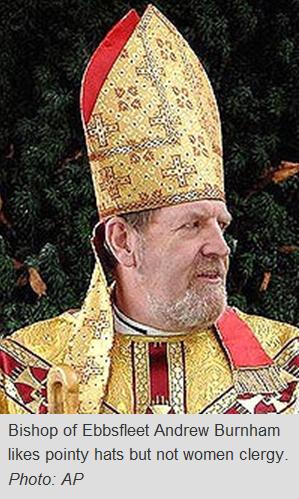
Fast upon the announcement that there are 5 Church of England Bishops poised to enter communion with the See of Rome through the Anglican Ordinariate, comes the announcement that as many as 50 priests may be accompanying them. Now for the lay-people!

This picture accompanied the story in The Age linked to above. The caption is a little “catty”. Since The Age sourced it from The Telegraph who sourced it from AP, it is hard to know who is to blame for the snide caption.

Hooroo to the Bishop Andrew, by the way. He has, on occasion, dropped by our table for a small glass of port.

Posted in Uncategorized | 12 Comments

Have I missed out a link to your blog?

As you can see, I have attempted to redo my links as the next stage of the rebuild of my blog. If I have overlooked your blog, please let me know.

Posted in Uncategorized | 8 Comments