The Conclave and St Joseph

At last! As of a couple of hours ago, we have a date for the start of the conclave. I stayed up for the 11pm (1pm Rome time) press conference and was disappointed when nothing emerged, but then woke to find that at their evening session, the Cardinals determined that the Conclave would start in the afternoon of the 12th of March.

Which is very nice because, although I was hoping for a pope BY my birthday (and we never do get everything we wish for), at least I get a consolation gift for my natal festival. Although strictly speaking, given that 10 hour time lapse, my birthday will be over by the time they go in. Or should I say, strictly speaking, it won’t be? Don’t know. All that timey-whimey, wibbly-wobbly stuff.

I’ve been trying to work the logic of all this out in my head, and it depends, I think, on how you read Universi Dominici Gregis paragraph 74 and its modification by Benedict XVI in Normas Nonnullas (no, please don’t ask me what Norma is doing with her nonnullus… that’s one for the canonists). Here are the two relevant paragraphs:

From Universi Dominici Gregis

74. In the event that the Cardinal electors find it difficult to agree on the person to be elected, after balloting has been carried out for three days in the form described above (in Nos. 62ff) without result, voting is to be suspended for a maximum of one day in order to allow a pause for prayer, informal discussion among the voters, and a brief spiritual exhortation given by the senior Cardinal in the Order of Deacons. Voting is then resumed in the usual manner, and after seven ballots, if the election has not taken place, there is another pause for prayer, discussion and an exhortation given by the senior Cardinal in the Order of Priests. Another series of seven ballots is then held and, if there has still been no election, this is followed by a further pause for prayer, discussion and an exhortation given by the senior Cardinal in the Order of Bishops. Voting is then resumed in the usual manner and, unless the election occurs, it is to continue for seven ballots.

And in Normas Nonnullas:

No. 75. “If the balloting mentioned in Nos. 72, 73 and 74 of the aforementioned Constitution does not result in an election, one day shall be dedicated to prayer, reflection and dialogue; in the successive balloting, observing the order established in No. 74 of the same Constitution, only the two names which received the greatest number of votes in the previous scrutiny, will have passive voice. There can be no waiving of the requirement that, in these ballots too, for a valid election to take place there must be a clear majority of at least two thirds of the votes of the Cardinals present and voting. In these ballots the two names having passive voice do not have active voice.”

Now, first, what does “after balloting has been carried out for three days” mean? Is it three days chronologically speaking – ie. 72 hours after the moment the conclave begins – or is it three days by the calendar inclusive of the day on which the conclave began?

Lets imagine. One thing we know (or think we know, and I think we can reasonably think that we do know) is that there is no favourite in this conclave. As usual, John Allen Jnr does a marvellous job of summing it all up here. I would be very surprised if we have, as last time, a new pope after just four votes. This could be a protracted affair.

But there is another game changer in the current situation. I do not expect that any of the Cardinals would like to face the situation envisaged in Benedict’s new rule about only two names going forward after the break for a day of prayer “after balloting has been carried out for three days”. Think of it. If voting has been going on for this long (9 to 12 ballots, depending on how you determine “three days”) it will obviously be a sign that the Cardinals are not reaching agreement easily. In such a circumstance, are they likely to reach agreement any more easily after the possibility of a “compromise candidate” is ruled out?

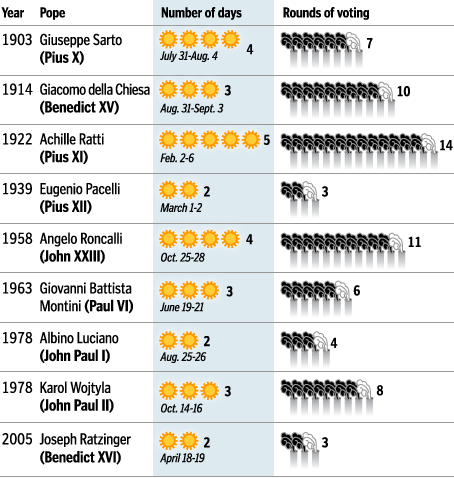
Just in case you think this scenario is not possible, here is a little graphic from the WaPo giving the conclave lengths for the 20th (and 21st so far) century:
conclave_041905

As you can see, three conclaves went for more than four days, and another three (not the same three) went for more than nine ballots. So it is possible. Note that John Paul II was elected on the third day after eight ballots.

Why is all this important? Because of timing. If the voting begins on Tuesday afternoon (Rome time), day three (calendrically) would be Thursday with a day of prayer on Friday and a return to the voting room (aka the Sistine Chapel) on Saturday. If we take three days as 72 hours, then Saturday would be the day of prayer, and there would not be a return to balloting until Sunday. Keep in mind that from the very beginning, Pope Benedict appears to have timed this in such a way that we will have a pope for Holy Week. No-one wants a Palm Sunday installation (all the Cardinals who are pastors of their sees will want to be home by then), so unless we have a week-day installation, you can be sure that the Cardinals are looking toward an installation mass on Sunday next, the 17th of March.

But by starting on Tuesday afternoon, rather than, say, Monday afternoon, are they cutting their rope a little bit short?

[update: I had this wrong. Fr Lombardi has clarified:

The Director of the Holy See Press Office also recalled the procedure in the case that a pontiff is not elected in the first four days of voting. In such an instance the cardinals will take a pause on the fifth day in order to pray, speak freely among themselves, and listen to a brief exhortation given by the senior cardinal in the Order of Deacons. The scrutinies will proceed in a similar fashion—two days of voting with every third day taken to pause for prayer—until the 34th vote on the afternoon of the eleventh day. In such an event, No. 75 of the Apostolic Constitution “Universi present and voting. In these ballots the two names having passive voice do not have active voice.” That is, the two candidates with the greatest number of votes will be voted for and cannot themselves cast a vote.

That makes much more sense..]

Anyway, St Joseph. I mentioned him in the title. He is one of my patrons, so at this time of year, heading up to his feast on the 19th of March, I do tend to look to his intercession. Cardinal Dolan has made a good suggestion:

I’m going to begin a novena to him on March 11, nine days of prayer in preparation for his feastday (two days after St. Patrick’s Day), asking him and his virgin-wife to look after the Church, and get us an inspired new Successor of St. Peter. Will you join me?

An excellent idea. And those clever guys who brought you the Confession App also have “an app for that”.

Posted in Uncategorized | 3 Comments

What +Coleridge said

On the ABC Religion and Ethics website, edited by Scott Stephens, Archbishop Mark Coleridge of Brisbane began by saying what I said here in a comment about “crisis” being a perennial condition in the Church and also implying “judgement”.

But he goes on to say much more (and I commend his words to you for reflection during this pre-conclave moment), addressing a lot of things, including the 1998 Statement of Conclusions and the Morris Affair.

Pastor Mark is still having a go at me on his blog, and that’s his prerogative. I just repeat what I have already said: the particular business of the sexual abuse crisis in the Catholic Church is not really my responsibility. I have a lot of other responsibilities as a lay person in the Church, including serving as the Executive Officer of the Ecumenical and Interfaith Commission, teaching my Anima classes, and above all caring for my family and bringing my children up in the fear and love of the Lord. That is more than enough to be going on with. I do believe that God has apportioned responsibility in the Church according to office, and the office of Church Government has not fallen to me. That is not a denial of the seriousness of the crisis – it is rather an affirmation of my own particular calling.

I would also like to thank Scott Stephens for a remarkably good job that he does in editing the ABC Religion and Ethics website. I am truly dismayed see Andrew West of the Religion Report developing in the same direction with the same bias and peddling the same misinformation that the previous holder of his position held. And listening to John Cleary on ABC Radio’s Sunday Night program and of course St Geraldine of Doogue on Compass is just an exercise in frustration. It seems to me that Stephens stands out head and shoulders above this pack as a true thinker, who can see more than just the canned version of the current situation in the Church and is capable of getting the real story told. That doesn’t mean that I always agree with him, but I do admire his work.

I am still waiting for my copy of George Weigel’s Evangelical Catholicism to land in my post box, but I have been reflecting somewhat on Benedict’s particularly evangelical message. I was listening to this interview with Cardinal Napier of Durban on Vatican Radio, and he made this particular point, with which I thoroughly agree, that “the idea of the centrality of Christ” was foremost for Benedict XVI. Benedict spoke of the “encounter with Jesus” in a way that is more usually heard in evangelical preachers, but which I sense now is becoming more and more common to hear from our bishops and pastors (Cardinal Weurl of Washington is one person in particular who strikes me as having a very strong sense of this evangelical christocentrism).

I hear this too in Archbishop Mark’s comments with regard to the “humiliation” which the Church is currently experiencing:

But my hope is that out of this experience of horror and humiliation that there will emerge a purified and more genuine moral authority, grounded in the truth of Jesus Christ crucified and risen, and not on the kind of moral pride which arises from our own sense of our supposed moral excellence.

It is precisely because I am convinced that the Catholic Church is where the Paschal Mystery of Christ is most fully encountered and experienced that I am confident that the gates of hell – and this present crisis seems to have sprung straight from that portal – will not prevail against the Church. It is not “pope worship” (as one unpublished commentator put it to me recently) that this ‘ere blog is concerned with, but the Gospel of Jesus. Paradoxically it is here, in this Holy Church of Sinners-Seeking-Healing, that I find Christ.

Archbishop Mark says:

This is a time when we’re under pressure. There is no question the Church in the West, not just in Australia, is under pressure. We’re passing through a time of what seems to be institutional diminishment, and the temptation in such a moment can be to retire to a kind of protective bubble. The image I often use is that of circling the wagons. But I think that would be a huge mistake. This is precisely the moment to go deeper into the faith – in other words, to discover a new depth, the magnificence and the power of the good news which is in Jesus Christ crucified and risen, and then to go out. We must take the risk of going out, of rolling the wagons into new territory and preaching the gospel in new and imaginative ways. I think that’s what is required.

What he said. Sentire Cum Ecclesia Christi.

Posted in Uncategorized | Leave a comment

Yes – I know – I’ve been hacked!

I am getting a lot of emails from people informing me that my yahoo email address has been hacked. I know. It has also resulted in that email address being locked down by Yahoo – I can receive your emails but I can’t reply to them.

I have taken the usual measure of changing my password on the account, and now have to wait about 24 hours for the account to come back online again (hopefully). I do not know how this happened, but I do apologise to anyone inconvenienced.

It may be that I have to ditch this email address and find a new one.

If any of you have any experience in this or any advice, please let me know.

Posted in Uncategorized | 3 Comments

On Singing the Mass

During Lent (and I think we will be doing it again in Advent) at St Philip’s Blackburn North, we are using the Gregorian chant Mass XVII setting for the ordinary of the mass. It is going quite well, I think. It seemed difficult to start with, but we are learning the patterns in the chant, and this is making it easier. We don’t sound like the monks of Solesmes but I don’t think that is a requirement. And odd thing happens when a congregation (rather than a choir) sings the chant – all the little rhythmical nuances get ironed out and it all becomes a little “plain” (I guess it IS plainchant afterall!). I am the chief of sinners here – we are so used to singing metred music that we find ourselves imposing something of a metre on the chant. But there you are. It is beautiful nonetheless in a “grass roots” kind of way!

We are also using the entrance chants from Illuminare Publications. These are much simpler than the “Simple English Propers“, and the congregation (and cantor) are finding them easy to grasp and sing.

I have recently come across two good articles on “Singing the Mass” (rather than “singing at mass”). The first is in The Catholic World Report (“The Renaissance of the Mass Propers“), which gives a comprehensive explanation of how to go about introducing singing the chant and the propers of the Mass. Our own Dr Paul Taylor even gets a mention and his advice is quoted.

The second is not so much an article as an episcopal decree – how one bishop in the States has decided to encourage his own “renaissance” of true “mass music” in his diocese (“Rejoice in the Lord always: Pastoral Letter on Sacred Music in Divine Worship”). I am not quite sure what the fate of this decree will be, since ten days after issuing it, Bishop Alex Sample was translated from the Diocese of Marquette to the Archdiocese of Portland. He does seem to be realistic in this directive and was not demanding a complete change in one hit. Rather he was setting out the ideal standard and giving suggestions for how the parishes of the diocese can work toward this goal. I wonder too whether he will try the same thing in Portland now? HT to Fr Z for this one.

I haven’t myself adopted a totalitarian approach to chant – nor has our parish. We still like our hymns. I know that apart from the sequences, hymns were never a part of the Roman Rite in its “pristine” form, but just because they were not so in the past need not mean they cannot be so in the present. As long as they meet the criteria for truly “sacred” music, that is. There. That ought to start an argument…

Posted in Uncategorized | Leave a comment

The Crisis of Evil in the Church

In the combox on an earlier post, commentary table member and Lutheran blogger, Pastor Mark Henderson, made this comment:

There you go, David – you don’t mention it.
The pope’s resignation is not the crisis, my friend – it’s symptomatic of the crisis.
The crisis is __________ . Fill in the blank, David.
Out of the mouths of babes – today my wife and eldest son and I drove past St Patrick’s Cathedral here in Toowoomba. I remarked “There is no Pope. Sede vacante -the see is empty.” My son, typical teenager, said, “Oh yeah, why did he resign?” My wife, a former Catholic from abroad whose leaving of the church some 20 years ago was directly related to loss of confidence (the plausibility problem) in the priesthood because of personal experience of the sexual abuse scandals, remarked, “He resigned because he discovered all the evil in the church and it broke his heart.”

I wrote out the following reply and decided to make it a blog post in its own right, rather than getting lost somewhere down the commentary list. Here it is:

What, you wanted me to say “sex abuse”? Happy now? No. I don’t talk about it very often. Because my reaction to it is just what your wife thinks Benedict’s was: it breaks my heart.

And yes, I am sure that it did break Benedict’s heart too. I am sure he knew a lot more about the evil in the Church than you, or I, or your wife or anyone could possibly know.

But to say that this is the reason he resigned? I don’t think so. He has had to deal with that particular evil his whole papacy. I am sure it wore him down, but… some other needle must have broken this particular camel’s back.

If “the crisis” to which you refer, Pastor Mark, is “evil in the Catholic Church”, well, then that truly is a crisis that has been with us since the beginning. It is the very same crisis that I find every time I look into my own heart and see what is there – more than you, or anyone else other than God, could know.

But perhaps one of the greatest evils that has come as a result of this particular evil is the fact that it has become the only evil we can see. It is like the person who goes to confession again and again and confesses the same sins each time. This particular sin becomes the only thing he can think about, the only thing he thinks he needs to repent of – and he does not realise the other more subtle evils affecting his life.

Yes, evil exists in the Church. This is not something to be accepted (“well, it has always been so, so why try to change it?”) but it is certainly not something we should be surprised at. I would have it that the whole world could look at the Church and see nothing but holiness and love – what an evangelising moment THAT would be! Instead the body of Christ is shamed and spat upon because of the betrayal of her members.

But should anyone stand like the pharisee in the temple and say to himself “God, I thank thee that my church is not like that one over there in the corner etc” – well… Pastor, if you and your wife and family have found a Christian community in which there is no evil, no crisis, I wish you luck.

I didn’t choose to become a Catholic because Catholics were more holy than other Christians. I wish it were so, but on balance I know that probably they are not. I chose to become a Catholic because I was convinced that the Catholic Church is the visible society upon earth in which the Church of Jesus Christ fully subsists. That is something quite different.

All that having been said, I do remain convinced that if one is seeking to become holy, then the Catholic Church is the place where the means of attaining holiness are most fully to be found. For all the dreadful, horrific evils committed by members and priests and leaders of the Catholic Church over all the centuries, yet I can name you so many more whose life here on earth, by the grace of Jesus Christ working within them, enabled them to reach that perfection of holiness in this life that there was no sin at all left in them from which they needed no be purified after their death.

Does that sound horrific to you? Does that scandalise you? It should not. Because I used the words “by the grace of Jesus Christ”. One thing you must say about us Catholics: we believe in the power of God’s grace – perhaps more than the most ardent protestant – because we believe that God’s Grace in Jesus Christ really CAN change lives and make sinners into saints.

That is – now and always and world without end – the answer to the crisis of which you speak: the crisis of evil in the Church.

Posted in Uncategorized | 22 Comments

A Lutheran Hymn for the Catholic Church at this time

Here is a hymn written by one of my favourite Lutherans – Pastor Nikolai Frederik Severin Grundtvig (1783-1872) – a contemporary and fellow-countryman of Danish Lutheran philosopher Søren Kierkegaard (1813 – 1855). I think it is a perfect hymn for Catholics at this time. Although we may balk at the opening line of verse two (given that we believe Christ is truly present in the Eucharist reserved in our “temples made with hands”), yet I think Grundtvig turns this statement around in the following verses to help us understand that through Word and Sacrament, he indeed “draws near” to us in our “earthly temples”. Click here to hear the tune (Kirk­en Den Er Et), which I think strikes the perfect note of confidence in crisis.

Built on the Rock the church doth stand,
Even when steeples are falling;
Crumbled have spires in every land,
Bells still are chiming and calling;
Calling the young and old to rest,
But above all the soul distressed,
Longing for rest everlasting.

Surely in temples made with hands,
God, the Most High, is not dwelling;
High above earth His temple stands,
All earthly temples excelling;
Yet He whom heavens cannot contain
Chose to abide on earth with men,
Built in our bodies His temple.

We are God’s house of living stones,
Builded for His habitation;
He through baptismal grace us owns,
Heirs of His wondrous salvation;
Were we but two His Name to tell,
Yet He would deign with us to dwell,
With all His grace and His favor.

Now we may gather with our King;
Even in the lowliest dwelling:
Praises to Him we there may bring,
His wondrous mercy foretelling;
Jesus His grace to us accords,
Spirit and life are all His words,
His truth doth hallow the temple.

Still we our earthly temples rear,
That we may herald His praises;
They are the homes where He draws near
And little children embraces,
Beautiful things in them are said,
God there with us His covenant made,
Making us heirs of His Kingdom.

Here stands the font before our eyes
Telling how God did receive us;
The altar recalls Christ’s sacrifice
And what His table doth give us;
Here sounds the Word that doth proclaim
Christ yesterday, today, the same,
Yea, and for aye our Redeemer.

Grant then, O God, wherever men roam,
That, when the church bells are ringing,
Many in saving faith may come
Where Christ His message is bringing:
“I know Mine own, Mine own know Me;
Ye, not the world, My face shall see.
My peace I leave with you.”

Posted in Uncategorized | 4 Comments

Frame Vacante

Do you, like me, now have several empty picture frames about the house? In the state of, let us say, “frame vacante”?

Well, here is the perfect picture of His Holiness, Benedict XVI*, Roman Pontiff Emeritus, for you to put in some other little picture frame on your bedside table or bookshelf (next to “Introduction to Christianity” and “Jesus of Nazareth: The Infancy Narratives”). Click on the picture to download the full sized shot.

b16pb5

I got it off Rocco Palmo’s blog. Goodness knows where he got it from. Its pretty high quality and shows Benedict (obviously taken when he was pope but) dressed in the manner of a Pontiff Emeritus (even with brown shoes) and sitting on a bench in the gardens of Castel Gandolfo.

(* It just occurred to me that the XVI might be in accurate there – as far as “Pontiffs Emeriti” go, he is the “first”, whatever name he wants to go by!)

Posted in Uncategorized | Leave a comment

“The Church is not mine, not ours, but His – and He shall not let her sink.”

From the last public audience of Pope Benedict XVI:

When, almost eight years ago, on April 19th, [2005], I agreed to take on the Petrine ministry, I held steadfast in this certainty, which has always accompanied me. In that moment, as I have already stated several times, the words that resounded in my heart were: “Lord, what do you ask of me? It a great weight that You place on my shoulders, but, if You ask me, at your word I will throw out the nets, sure that you will guide me” – and the Lord really has guided me. He has been close to me: daily could I feel His presence. [These years] have been a stretch of the Church’s pilgrim way, which has seen moments joy and light, but also difficult moments. I have felt like St. Peter with the Apostles in the boat on the Sea of Galilee: the Lord has given us many days of sunshine and gentle breeze, days in which the catch has been abundant; [then] there have been times when the seas were rough and the wind against us, as in the whole history of the Church it has ever been -and the Lord seemed to sleep. Nevertheless, I always knew that the Lord is in the barque, that the barque of the Church is not mine, not ours, but His – and He shall not let her sink. It is He, who steers her: to be sure, he does so also through men of His choosing, for He desired that it be so. This was and is a certainty that nothing can tarnish. It is for this reason, that today my heart is filled with gratitude to God, for never did He leave me or the Church without His consolation, His light, His love.

Sentire cum ecclesia, my friends. And “Maior autem his est spes”.

Posted in Uncategorized | 1 Comment

Are they just trying to make a confusing situation even more confusing???

On 22nd February, Cardinal Francesco Coccopalmerio, the president for the Pontifical Council for Legislative Texts, announced that Benedict XVI will, after his abdication takes effect, be referred to as the “Bishop Emeritus of Rome”. We wrote about that at the time and all agreed that it was the right title. We remember Pope John Paul II’s quip “There’s no place in the Church for a Pope Emeritus”.

Then this morning, the same dear lady who rang me at 6:30am on February 12 to tell me that the Holy Father resigned, rang again at the same hour to tell me “He will have his last mass on Wednesday and then he won’t wear his red shoes anymore and he will be called Pope Emeritus”.

Dear, oh dear, I thought, when will the secular media get it right? Why this fascination with trivia and failure to understand plain Italian?

Well, imagine my surprise when I finally read the report of Fr Lombardi’s latest press conference in which he announced:

1) Benedict XVI will be “Pontiff emeritus” or “Pope emeritus”

2) the Pope will no longer wear the red papal shoes

Don’t get sidetracked by the red herring – I mean, shoes. What’s going on with the title business? I would have thought that the Cardinal President of Legislative Texts was a pretty authoritative source for the post-papal title. Did Fr Lombardi get confused, or has there indeed been a rethink of the title since Cardinal Coccopalmerio’s announcement? And who would have the authority to call the shots on this one?

Is it possible that His Holiness himself decided his predecessor was wrong, and that “Pope Emeritus” is a more fitting title than “Bishop-Emeritus of Rome”?

It should be a simple matter, but unfortunately, hearing one thing from the Cardinal and one thing from Fr Lombardi has just left me confused. And at this time in the Church, confusion is one thing that we do not need more of.

As for the Holy Father’s “last mass” today – I think my dear friend was just confused.

Posted in Uncategorized | 17 Comments

Why Lutherans can thank God for the Papacy of Benedict XVI

I have been asked to pen a few words for my wife’s parish newspaper on Benedict XVI’s papacy. I thought I would focus on his relationship with Luther and the Lutherans. I hope the editor of the magazine does not mind me publishing it ahead of time here on my own page.

On February 28, 2013, at 8pm in the evening, Pope Benedict XVI’s papacy comes to an end. Everyone has a different assessment of his papacy, each from their own point of view. From my point of view, as a “Lutheran in communion with the Bishop of Rome”, Benedict XVI will always stand out as unique among all the popes of history as the only one who really read, knew, and understood Martin Luther.

Part of the reason for this is that Benedict XVI is a German. Except for John Paul II (who came from a country even more uniformly Catholic than Italy), all other popes since Adrian VI (d.1523) were Italians. Not one of them had any first-hand lived experience of Lutheranism. Joseph Ratzinger on the other hand was raised in an environment where Catholics and Lutherans lived side by side. Since Luther forms part of the literary heritage of Germany, his bible and his writings were easily accessible to the young Ratzinger, who once claimed that he had already read all of Luther’s pre-reformation writings by the time he entered University. He continued his theological education in German universities where both Protestant and Catholic theologians and biblical exegetes were studied.

All of this would have greatly helped him understand the theological issues that divided and still divide Catholic and Lutherans. It was this background that gave him such a great advantage when he was negotiating the final deal on the Joint Declaration on the Doctrine of Justification in 1999. It was Cardinal Ratzinger, as head of the Congregation of the Doctrine of the Faith, who saved this Declaration from a dismal death at the draft stage. Cardinal Cassidy, the Australian prelate who was the head of the Pontifical Council for the Promotion of Christian Unity at the time, had given up on it. But Ratzinger travelled to Germany, where, in his brother Georg’s home, he met together with Lutheran leaders to find the right formulas for affirming the joint faith of Catholics and Lutherans in regard to the doctrine of Justification. Thanks to this rescue mission, the Joint Declaration was signed into concrete history on October 31, 1999:

Together we confess: By grace alone, in faith in Christ’s saving work and not because of any merit on our part, we are accepted by God and receive the Holy Spirit, who renews our hearts while equipping and calling us to good works.

In an address in November, 2008, Pope Benedict addressed the central passage in Paul that caused so much division between Catholics and Lutherans.

Let us now reflect on a topic at the centre of the controversies of the century of the Reformation: the question of justification. How does man become just in God’s eyes?…

It is precisely because of his personal experience of relationship with Jesus Christ that Paul henceforth places at the centre of his Gospel an irreducible opposition between the two alternative paths to justice: one built on the works of the Law, the other founded on the grace of faith in Christ. The alternative between justice by means of works of the Law and that by faith in Christ thus became one of the dominant themes that run through his Letters…

Luther’s expression “sola fide” is true if faith is not opposed to charity, to love. Faith is to look at Christ, to entrust oneself to Christ, to be united to Christ, to be conformed to Christ, to his life. And the form, the life of Christ, is love; hence, to believe is to be conformed to Christ and to enter into his love.

“If faith is not opposed to charity” – that was always the Catholic concern. In Catholic dogmatic tradition, faith was often seen as an intellectual exercise. Thinking of faith in this way made it impossible for Catholics to affirm that “faith alone” could justify. But Pope Benedict understood the way in which Luther (and no doubt St Paul) meant “faith”: a complete self-entrustment to Christ, which had the spiritual effect of conforming the soul to Christ in such a way that a true union with Christ was effected. It was as unimaginable to Luther that such faith could ever be without love as it was to St James and St Paul (cf. James 2:14f).

Benedict was the first pope ever to preach from a Lutheran pulpit (at the Roman Lutheran Church in March 2010) and the first to visit Luther’s monastery in Erfurt in September 2011. On that latter occasion, he met with Germany’s Lutheran Church leaders. In his speech, he correctly identified the two driving issues for Luther: “Wie kriege ich einen gnädigen Gott” (“How do I find a gracious God?”) and “Was Christum treibet?” (“What promotes Christ?”)

In respect to the first question, Pope Benedict said:

The fact that this question was the driving force of his whole life never ceases to make a deep impression on me. For who is actually concerned about this today – even among Christians? …The question no longer troubles us. But are they really so small, our failings? …The question: what is God’s position towards me, where do I stand before God? – Luther’s burning question must once more, doubtless in a new form, become our question too, not an academic question, but a real one. In my view, this is the first summons we should attend to in our encounter with Martin Luther.

And in reflection on the second, he said:

God, the one God, creator of heaven and earth, is no mere philosophical hypothesis regarding the origins of the universe. This God has a face, and he has spoken to us. He became one of us in the man Jesus Christ – who is both true God and true man. Luther’s thinking, his whole spirituality, was thoroughly Christocentric: “Was Christum treibet” was for Luther the decisive hermeneutical criterion for the exegesis of sacred Scripture. This presupposes, however, that Christ is at the heart of our spirituality and that love for him, living in communion with him, is what guides our life.

It is certainly what was at the heart of Ratzinger/Benedict’s own spirituality, and why I believe he was a very “Lutheran” pope. Many commentators will tell you that Ratzinger’s theology was “Christological” – but it was more than this: it was “Christocentric”. Christ was at the centre of his faith and theology in a way that was quite new in Catholic papal teaching. Again and again, you will find references in Benedict’s teaching to seeking the face of God in the human Christ. References to a “theology of the Cross” and a focus on the personal aspect of the mystery of the incarnation permeate Benedict’s teaching as strongly as it did Luther’s.

Perhaps this is why Pope Benedict XVI was such a strong promoter of the “new evangelisation” in our age. He was an “evangelical” pope, who knew that faith begins with a personal encounter with Jesus. He opened his first encyclical, “Deus Caritas Est” (God is Love), with these words:

Being Christian is not the result of an ethical choice or a lofty idea, but the encounter with an event, a person, which gives life a new horizon and a decisive direction.

As he retires to a life of prayer, precisely to enter more deeply into that encounter with his Lord, Benedict XVI leaves us with a body of decisive papal teaching that will pave the way for future reflections between Lutherans and Catholics. Although we cannot perhaps hope that the new pope will have the same depth of appreciation for Lutheranism as his predecessor, it is my prayer that the relationship between Catholics and Lutherans which he fostered will grow and bear fruit in the years to come under the new papacy.

Posted in Uncategorized | 14 Comments